


Does your dog howl? Rest in a frog-like sprawl across the living room floor? Or struggle with anxiety, allergies or other health conditions?
For the past decade, we've been asking dog owners questions like these through Darwin's Dogs. Today, it's one of the largest community science efforts focused on dogs. Combined with DNA samples from thousands of participating dogs, those observations have helped researchers explore everything from cancer and canine behavior to working dogs and how wolves evolved into dogs.
Some discoveries confirmed what scientists suspected. Others challenged long-held assumptions. All of them were made possible by a community of dog lovers willing to share what they know best: their dogs.
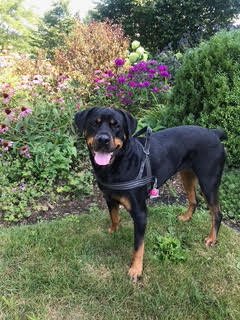
One of those is Elsa, a Rottweiler whose owner, Jen, enrolled her in Darwin's Dogs.
Elsa spent six years as a service dog for Jen's daughter, performing complex tasks and helping keep her safe. At one point, Elsa even tracked her down after she became separated from her family at a crowded festival. Later in life, Elsa faced several significant health challenges, including osteosarcoma and squamous cell carcinoma.
Experiences like Elsa's are one reason many dog owners choose to participate in Darwin's Dogs.
"I thought Elsa's medical history may help future Rottweilers," Jen said.
Helping researchers take on cancer
Cancer is one of the most common causes of death in dogs, but many questions remain unanswered about why some dogs develop cancer while others do not.
Through the Darwin's Dogs Cancer Project, researchers combine DNA data with owner-reported health histories and environmental information to better understand the factors that influence cancer risk. Because dogs naturally develop many of the same cancers as humans, those discoveries can benefit both species.
Over the years, Darwin's Ark researchers have helped uncover genetic drivers of several canine cancers, including osteosarcoma, hemangiosarcoma and liver cancer. In 2025, Darwin’s Ark researchers led the first study to map the genetic makeup of canine oral osteosarcoma, a rare and aggressive bone cancer that begins in a dog's jawbone. The study found genetic similarities between this rare cancer and more common forms of bone cancer in both dogs and humans.
Every survey, health update and DNA sample helps researchers ask new questions about canine cancer and the factors that may influence disease.
Challenging assumptions about breed
Ask a group of dog owners to describe a golden retriever, border collie or chihuahua, and you'll probably hear many of the same traits repeated.
Friendly. Focused. Feisty.
For years, both scientists and dog owners have wondered how much of a dog's behavior comes from breed and how much comes from lived experience.
Darwin's Dogs helped tackle that question by combining DNA data with behavioral surveys completed by thousands of community scientists.
Researchers found that breed explained just nine percent of the differences in behavior among individual dogs. While breed can influence certain physical traits, it turned out to be a much smaller piece of the behavioral puzzle than many people expected.
"What we really wanted to do was study dogs as individuals rather than putting them into categories," Darwin's Ark Co-Founder and Chief Scientist Dr. Elinor Karlsson said. "Breed is part of the story, but a dog's experiences, environment and puppyhood matter, too."
The findings reinforced something many dog owners already know: a dog's breed can tell you a lot about its ancestry, but not much about its personality.
Why some dogs excel at certain jobs
If breed isn't the whole story, then what helps some dogs excel as service animals, detection dogs, livestock guardians and other working dogs?
That's one of the questions researchers are exploring through the Working Dog Project.
Darwin's Ark has partnered with the International Working Dog Registry, a nonprofit that provides working dog organizations with breeding selection tools and data management services. Together, researchers are studying the behavioral and genetic traits that help working dogs succeed.
Working dogs often rely on a unique combination of characteristics, such as responsiveness to human instruction, a strong sense of smell and the ability to work confidently in unfamiliar environments. By combining DNA data with behavioral information shared by owners and handlers, researchers hope to better understand the traits that make a working dog successful.
What wolf-dog hybrids can teach us
Though it's sometimes hard to see, every dog, from a chihuahua to a Great Dane, traces its ancestry back to wolves.
But exactly how wolves evolved into dogs remains one of the biggest questions in canine science.
Through the Wolf-Dog Hybrid Project, researchers study animals living in sanctuaries that carry both wolf and dog ancestry. By comparing DNA data with behavioral observations, scientists can explore how genetics influence traits that differ between wild wolves and domestic dogs, such as reactions to unfamiliar people, objects and environments.
Wolf-dog hybrids provide a rare opportunity because each animal carries a unique mix of wolf and dog DNA. By comparing those genetic differences with behavior, researchers hope to better understand the traits that changed as wolves gradually adapted to life alongside humans and evolved into the dogs that now share our homes.
Science, one puppy video at a time
Not every Darwin's Dogs discovery begins with a DNA sample.
Pounce!, a project launched by Darwin's Ark affiliate scientists in the Karlsson Lab at UMass Chan Medical School, asks community scientists to help researchers study puppy behavior by watching and categorizing short videos of puppies playing.
Volunteers for Pounce! first complete a brief tutorial to learn how to identify one specific puppy behavior called "grab-bite." The pilot project is designed to determine whether many volunteers can identify that behavior as accurately as a small group of experts.
If successful, this could help researchers overcome one of the biggest challenges in behavioral science. Modern cameras can capture thousands of hours of animal behavior, but researchers don't have enough time to analyze it all themselves. Community scientists could help make large-scale behavioral research possible.
By helping identify puppy behaviors, volunteers create data that researchers can use to better understand when those behaviors first emerge in puppies and what they might reveal about how dogs evolved from wolves.
No science degree required, just a keen eye and a love of dogs!
If you're interested in learning more about Pounce! or participating as a community scientist, visit the Pounce! website to create an account.
Every observation matters
A decade of discovery has been built one survey, DNA sample and observation at a time. From submitting DNA samples and sharing stories about their own dogs to helping researchers analyze puppy videos, community scientists have played a vital role in advancing dog research.
Ten years after Darwin's Dogs began, one thing has become clear: some of the most important discoveries happen when scientists and community scientists work together.
In our next blog, we'll explore what's next for Darwin's Dogs and how participants will help shape the next decade of discovery.

