


Earlier this week, Darwin’s Ark released the first ancestry insights for nearly 2,000 cats participating in our sequencing research. The findings offer one of the first large-scale looks at how domestic cats across the United States are genetically related and point to birthplace, rather than breed, as the predominant predictor of most cats’ ancestry.
The scale and diversity of the sequenced cohort were made possible by our community science model, which brought together cats born across the U.S. and a small number of internationally born cats. This large sample size and geographic spread provides a more representative view of U.S. cat population structure than is typical of feline genetics studies, which often have smaller sample sizes or a focus on purebred cats.
The ancestry insights reveal a striking difference between the population structure of U.S. dogs and cats. In dogs, genetic populations cluster strongly by breed. In cats, they cluster strongly by geography. Cats with significant breed ancestry are relatively uncommon, accounting for only 7.3% of Darwin’s Cats sequenced so far.
For most cats, then, ancestry is less about recognized breeds and more about the places where their ancestors lived. Four broad patterns are emerging from Darwin’s Cats’ DNA sequencing research:
- Regional Roots: Cats with predominant ancestry from one or two geographic regions.
- Breed Legacy: Cats with predominant ancestry from one or more recognized breeds.
- Rich Tapestry: Cats with ancestry from several regional and/or breed populations.
- Uncharted Territory: Cats whose ancestry is likely not well-represented by populations in the Darwin’s Cats reference panel.

These categories provide an initial framework, not a final answer, for understanding cat ancestry. As more cats are sequenced and the reference panel expands, researchers can continue refining our understanding of cat ancestry.
Many Darwin’s Cats community scientists may be curious about what makes their own cats unique. But together, their data is answering bigger questions: What do our cats have in common? How are cats across the U.S. related? And what can their genetics tell us about their shared history and evolution?
Geography tells most cats’ ancestry stories
The most common ancestry pattern emerging from our sequencing research is Regional Roots: cats with the majority of their ancestry from one or two geographic cat populations. More than two-thirds of sequenced Darwin’s Cats fall into this category, making geography a powerful lens for understanding cat genetic diversity and population structure in the United States.
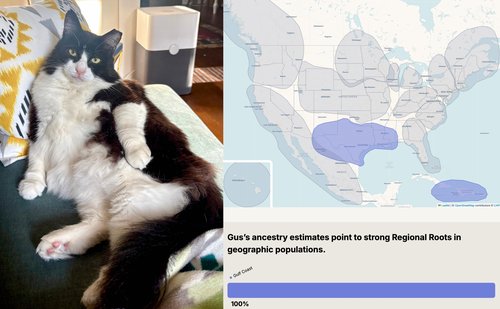
Our reference panel currently includes distinct genetic clusters from 13 U.S. regions and three broad international regions. By comparing a cat’s DNA with high-quality genetic sequences from cats in these regional populations, researchers can identify regions where that cat likely has ancestral roots.
These regions aren’t set in stone. As more cats are sequenced, these regions’ boundaries and our understanding of the populations within them may change.
For example, take Robert, an Arabian Mau born in Oman. Our model estimates that he has 100% Central Eurasian and North African ancestry, a result that lines up nicely with his known birthplace. As more internationally born cats join the reference panel, we expect Robert’s ancestry story to come into even sharper focus.
Then there’s Albus, a former Philadelphia shelter kitten who has since grown into a majestically fluffy cat. He shows strong Northeastern Core ancestry, along with smaller estimates from the Mid-Atlantic and Ohio River Valley. Do these smaller estimates reflect roots in all three of these regions, or could Philadelphia’s proximity to the boundary between the Northeast Core and Mid-Atlantic clusters play a role? For cats like Albus, smaller estimates in their ancestry insights may shift as more cats join our research.

For now, the takeaway from Darwin’s Cats’ sequencing research is clear: for most cats, where their ancestors lived reveals much more about their ancestry than whether they belong to a particular breed.
Breed cats are the exception, not the rule
For most cats, breed plays little to no role in their ancestry story. Just 7% of the cats we’ve sequenced show 85% or more of their ancestry from recognized breeds.
These cats’ genomes reflect generations of selective breeding, making them more genetically similar to cats of the same breed than to cats from the same geographic region. Among U.S. cats, they’re genetic outliers.
The rarity of cats with strong breed ancestry isn’t necessarily surprising. Many cat breeds were established only in the past 50 to 75 years, a relatively short chapter compared with the millennia cats have bred freely without human intervention.
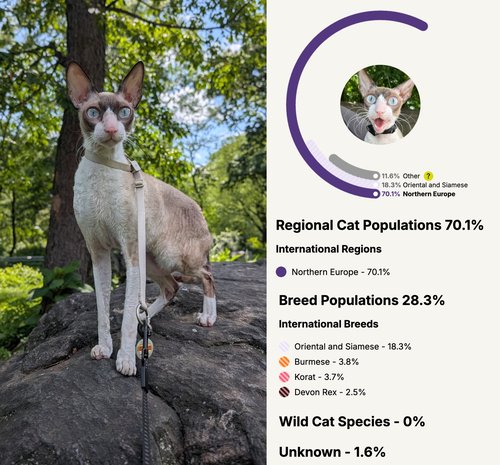
Our reference panel currently includes whole-genome sequencing data from pedigreed cats representing 21 recognized breeds. This is a limited dataset compared to the 46 breeds recognized by the Cat Fanciers’ Association and 73 breeds recognized by The International Cat Association.
Some breeds in the reference panel can’t yet be genetically distinguished from one another. Exotic, Persian, or Himalayan cats, for example, currently have indistinguishable genetic signatures in our reference data, likely because of the breeds’ intertwined histories and the limited number of cats representing them in our reference data.
Interestingly, a pedigreed cat can fall into our Regional Roots category if its breed isn’t yet represented in our reference panel. For example, Cornish Rex cats in our research show strong Northern European ancestry. That’s consistent with the breed’s origin in Cornwall, England. Although our model can’t yet identify Cornish Rex ancestry specifically, their ancestry results may still reflect that geographic history.
Sequencing more pedigreed cats should help us distinguish breeds more precisely and better understand how they fit into the broader cat population.

Some cats’ ancestry insights are coats of many colors
Nearly three in four cats we’ve sequenced have ancestry that can be explained relatively neatly by either geography or breed. But for the rest of Darwin’s Cats, their ancestry insights are more convoluted.
Roughly 20% of the cats we’ve sequenced so far fall into a category we’re calling Rich Tapestry. These cats show genetic similarities to several populations, which may represent geographic regions, breeds, or both. Their ancestry is complex, with no single population telling the entire ancestry story.
The name “Rich Tapestry” reflects the many distinct signatures researchers see in these cats’ DNA. Each signature offers a clue about one part of a cat’s ancestry. Put them together, and a richer picture of their genetic history begins to emerge.
Some Rich Tapestry cats, like Maverick, have genetic ancestries that can be linked to breeds and geographic populations represented in our reference panel. Others have ancestry that is more difficult to define with currently available reference data.

One such example is Arnold, a neighborhood cat from Miami. He shows strong genetic roots in Florida, along with numerous smaller, lower-confidence estimates. Those estimates could be accurate, but more likely reflect parts of Arnold’s ancestry that aren’t yet well represented in our reference panel.
For Rich Tapestry cats like Arnold, their ancestry estimates could point to where our reference panel may be limited. Arnold has ancestry estimates similar to those of cats born in the Caribbean, suggesting Arnold may have ancestry from a Caribbean subpopulation. Currently, we do not have enough reference data from Caribbean cats to confidently map that population in our ancestry estimation model.
In some ways, cat ancestry shows some parallels to human ancestry. Darwin’s Cats is finding that geography plays a significant role in cat ancestry, but movement and mixing between populations can create more complicated stories. Understanding these ancestry stories requires looking beyond breed structure and tracing the many genetic threads that connect populations across regions and generations.
What discoveries lie in uncharted territory?

Some cats participating in Darwin’s Cats are really unique…to the extent that there aren’t many cats like them in our genetic ancestry reference data. Uncharted Territory is a small but special group whose ancestries are difficult to trace using the populations currently represented in our reference panel.
For these cats, their ancestry estimates don’t fully align with what researchers know about them, including where they were born. Many come from breeds or parts of the world that are not well represented in our reference panel, which currently includes just three broad international regions: Northern Europe, Central Eurasia & Northern Africa, and East Asia.
Take Fern, who was born in Guam. Because that part of the world isn’t represented in our reference data, our ancestry estimation model searches for the most genetically similar populations available, resulting in a mix of estimates that may not reflect Fern’s true genetic ancestry.
Uncharted Territory cats are especially valuable to our research because they can reveal gaps in our understanding of feline genetic diversity and point toward populations that need more study.
Putting Uncharted Territory cats on the map will take more sequencing data from cats with diverse backgrounds. As our reference dataset expands, so too will our genetic map, and some cats currently classified as Uncharted Territory may eventually connect to geographic cat populations that we have yet to study thoroughly.
For now, Uncharted Territory cats are a reminder of just how much there is still to discover about cat ancestry.
What is your cat’s ancestry story?
Curious what your cat’s DNA might reveal? Log in to your Laboratory to check out their ancestry results, or sequence their DNA to help put more cats on our growing genetic map.
Learn more about our ancestry findings here.

