


Have you ever wondered if your cat is part Maine Coon, Siamese, or another breed? Many cat owners are curious to know where their cats come from, but the answer often lies beyond breed labels.
In the coming months, Darwin’s Ark will begin releasing ancestry results for cats participating in our genetics research. Unlike dogs, most cats in the United States can’t trace their ancestry to recognized breeds. Instead, their DNA reflects lineages from regional cat populations that have lived and migrated alongside humans for thousands of years. Some cats have purebred or mixed-breed ancestry, but for most of the global pet cat population, breed is just one chapter in the much larger story of feline ancestry.
So, what exactly is a cat breed? And if most cats aren’t purebred, then what does their DNA reveal about where they come from?
What is a breed?
A breed is a group of domestic animals that all descend from the same founding population. People purposely select this founding group typically because these animals display one or more appealing aesthetic traits, such as tufted ears, spotted coats, or blue eyes. Breeders selectively mate these cats and their descendants over many generations until the desired trait is reliably passed down from parents to kittens.
Because members of a breed share common genetic ancestry, they have similar physical characteristics. For cats, organizations like the Cat Fanciers’ Association (CFA) and The International Cat Association (TICA) recognize breeds and set standards describing each breed’s appearance.

Once a stable breeding population is established, breeders “close the studbook,” meaning no outside bloodlines can be added to the gene pool. From that point forward, the population is closed and is considered a distinct breed. Only cats descended from registered breed members can mate with one another and produce kittens that are considered purebred.
But every breed has to start somewhere.
One breed’s origin story: the Scottish Fold
To better understand how a cat breed begins, let’s look at the origin story of Scottish Folds, a breed of cat known for their folded ears.
Every Scottish Fold alive today traces their ancestry to Susie, a white barn cat who lived on a farm in Scotland in the 1960s. Susie had a genetic mutation that gave her distinctive folded ears. She had only one litter, and her two kittens both inherited the same folded ears. One of those kittens, a female named Snooks, was adopted by neighboring farmers and cat enthusiasts William and Molly Ross.
With the help of a geneticist, the Rosses bred Snooks with other cats while selecting for the folded-ear trait. Over several generations of cats, they established a population of cats that consistently inherited folded ears. In 1970, the United Kingdom's Governing Council of the Cat Fancy (GCCF) officially recognized the Scottish Fold as a breed.
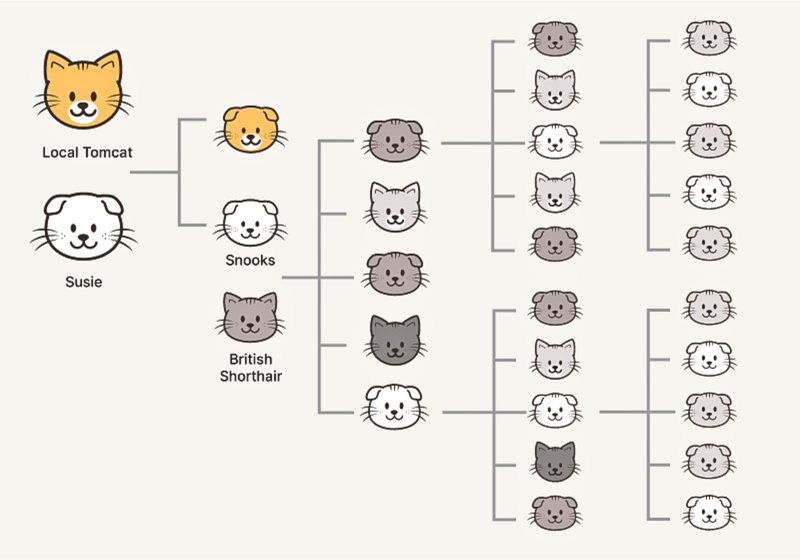
Before there were Scottish Folds, there was Susie. Snooks and her descendants were crossed with British and American Shorthairs. After several generations, the folded-ear trait was consistently inherited, allowing the Rosses to “close the studbook” on this stable breeding population. (It took far more than three generations to establish a closed breeding population. This diagram is simply a condensed overview of how a genetic mutation in a single cat eventually gave rise to one of the most recognizable cat breeds today.)
What isn’t a breed?
It’s easy to assume that if a cat looks like a Scottish Fold, then it must be one. However, that’s not how breeds work.
Not every cat with folded ears is a Scottish Fold. To belong to the breed, a cat also must have a pedigree—a documented family tree showing that they descend from the breed’s founding population. Folded ears are one hallmark of the breed, but pedigree, not appearance alone, determines whether a cat is truly a Scottish Fold.
The same concept applies to every recognized breed. Appearance alone doesn’t reveal whether a cat is a pedigreed cat. For example, tuxedo, tortoiseshell and tabby are familiar labels that describe coat colors and patterns, not breeds. They tell us what a cat looks like, not where a cat comes from.
Similarly, “domestic shorthair” and “domestic longhair” aren’t breeds either. They’re catchall terms that veterinarians use to refer to cats with unknown ancestry. (To make things even more confusing, American Shorthair and British Shorthair are recognized breeds. Despite the similar names, these breeds are entirely different from the generic “domestic shorthair.”)
Most cats don’t belong to a breed. They don’t have pedigrees because their ancestors weren’t part of original breeding populations established after breeders “closed the studbook.” Instead, most descend from much larger and genetically diverse populations of free-living cats that have been mating without human intervention for thousands of years.
Breed is just one way to talk about ancestry
Domestic cats have lived alongside humans for thousands of years, but most cat breeds are only about 50 to 100 years old. That means that cats have spent millennia mating without the human-made confines of pedigrees or breed standards. For most of history, cats lived around farms, villages, and shipping ports where they wandered in and out of human homes and had litters with other cats in the neighborhood.

Even today, most kittens aren’t born as part of planned breeding programs. They’re born to cats whose ancestry was never recorded, whether they live in human homes, barns, or feral colonies. Every so often, an unspayed or unneutered pedigreed cat slips outside, finds a mixed-ancestry mate, and contributes a bit of breed DNA to the local gene pool. But over time, those breed genes become just one small thread woven into a much larger genetic tapestry.
The relationship between breed and ancestry is one of the biggest differences between cat genetics and dog genetics. In the U.S., most dogs have ancestry from at least one recognized breed. That’s partly because the U.S. has relatively few environments that allow free-roaming dog populations to survive and reproduce over many generations. Cats, on the other hand, are frequently found living alongside humans without belonging to any one human in particular. Barns, warehouses, sheds, and cellars offer cats shelter, while rodents provide a steady food source. As a result, large free-living cat populations have continued to thrive alongside pedigreed cats.
Breed, then, is just one way to talk about a cat’s ancestry. And for most cats, breed isn’t the most informative ancestry story encoded in their DNA.
Genetic sequencing can reveal if a cat descends from pedigreed cats, regional populations of non-breed cats, or a mix of both. While a small portion of all cats are pedigreed, most cats have genetic heritage tracing back to regional populations that have lived alongside humans for thousands of years. Their ancestors may have hunted mice in medieval castles, prowled ancient port cities, or crossed oceans aboard merchant ships. Those journeys left genetic signatures that many cats carry today.
If you’ve ever wondered whether your cat has breed ancestry simply because of the way they look, there’s a chance that the real answer may be far more surprising. Regardless of your cat’s pedigree status, their DNA tells a fascinating story. For most cats, breed is just one chapter in a much longer tale.

If you’re curious how your cat’s ancestry fits into pet cats’ genetic puzzle, click here to learn more about participating in our genetics research. By sequencing your cat's DNA with Darwin’s Cats, you’ll help researchers unlock the mysteries of feline genetics, and you’ll be among the first community scientists to receive your individualized ancestry results for your cat.

