


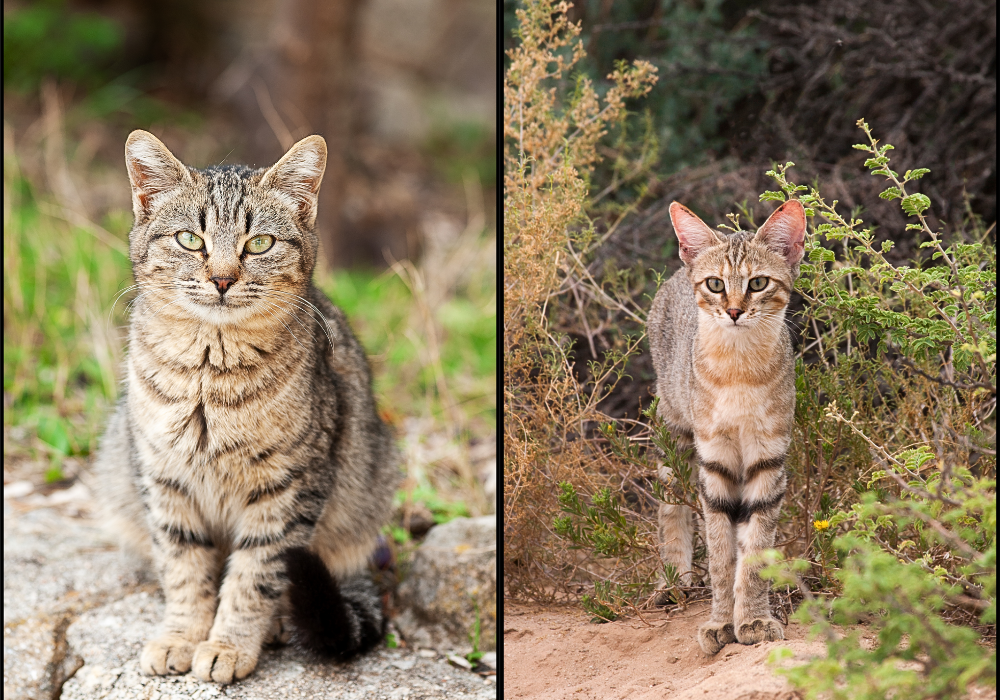
“What kind of dog do you have?” For dog owners, it’s a familiar question with an answer based on their dog’s breed(s): Labrador, Poodle, supermutt. But try asking a cat owner the same question, and it usually solicits a story rather than a breed breakdown: “They came from the city shelter,” or “I found them as a stray behind my apartment.”
Animal lovers are naturally curious about their pet’s ancestry: where they came from and how they’re related to other animals. Scientists explore these questions by studying DNA. Individuals that share similar genetic patterns are more closely related and tend to share ancestors.
In humans, ancestry often refers to the geographic origins, ethnic origins, or heritage of one’s ancestors. In dogs, at least in the United States, ancestry is driven by breed composition: dogs of the same breed are more genetically similar than dogs from different breeds.
Cats may have genetic ancestry that is more like humans than dogs. Early findings from Darwin’s Cats’ sequencing research suggest that cats born in the same geographic region are more genetically similar than cats born far apart.
While there’s much to be learned about feline ancestry, scientists are confident about the beginning of cats’ evolutionary story. Tens of thousands of years ago, the domestic cat’s ancestor—the African wildcat—roamed habitats throughout Africa, parts of the Middle East, and Western Asia. Today, wildcats’ domesticated descendants live all over the world, prowling neighborhood sidewalks, roaming farm fields, and curling up on cozy couches.
What happened between these two time points to evolve wildcats into one of humans’ closest companions? How and when did cats disperse across the globe? These questions captivate scientists and cat lovers alike, and lie at the heart of research into feline ancestry.
Cat research has been historically underfunded, which means that there are large gaps in science’s understanding of where cats came from and how they became domesticated. However, Darwin’s Cats is working to help close these knowledge gaps. Early findings from our DNA sequencing research are revealing new insights into feline genetics that suggest that tracing cat ancestry requires a different approach than how scientists trace dog ancestry.
Large-scale genetic sequencing helps decode cat ancestry
While most pet dogs in the U.S. have one or multiple breeds in their ancestry, most cats are random-bred. Science is still learning about how genetically differentiated domestic cat breeds are from one another. And genealogically, most cats have no pedigree (more on cat breeds, or lack thereof, in an upcoming blog post).
Advanced sequencing techniques like whole-genome sequencing allow scientists to compare DNA across many individuals or populations. When applied at scale, genetic sequencing can reveal unexpected patterns about where animals come from and how they’re related.
Preliminary findings from Darwin’s Cats indicate that genetically, U.S. cats cluster by geography rather than by breed. Cats born near one another tend to be more genetically similar than cats born far apart, even if they have very different physical traits or carry different breed labels. (By contrast, a Golden Retriever living in Massachusetts is genetically much more similar to a Golden Retriever in California than a Chihuahua that lives in their neighborhood.)

Genetic similarity among Darwin’s Cats. Each point is an individual cat, colored by the cat’s birth region. Points that are close together are genetically more similar, and points placed far apart on the plot are genetically more differentiated. This chart incorporates genetic data from 379 cats—will this trend continue as the sample size increases to 1,000 or more cats? Stay tuned for updates from Darwin’s Cats’ genetic sequencing research.
This pattern of genetic clustering by geographic location is similar to what scientists have seen in human populations: people from the same geographic region tend to share more ancestry than people separated by large distances. Over time, this is likely due to people having children within nearby regions rather than migrating across long distances.
The “Isolation-By-Distance model of genetic relatedness” describes this phenomenon. When researchers plot genetic relatedness among people of European ancestry, the resulting image mirrors a map of Europe itself.
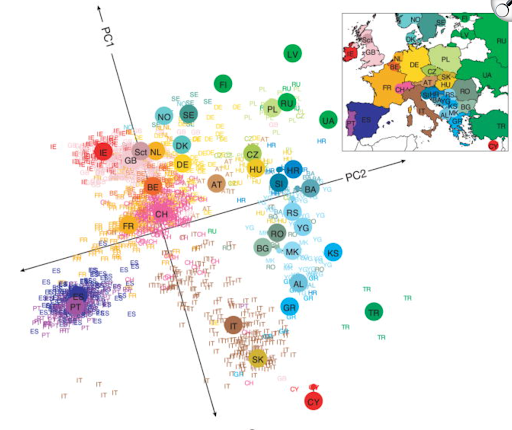
Genes mirror geography within Europe. Novembre, et al. Nature (2008): The “genetic map” of the two largest axes of genetic relatedness among individuals from Europe uncannily mirrors a geographic map of Europe. Each individual represented in the plot is colored by their country of origin.
Generating the best insights into the population structure among individuals from these “genetic maps” requires large genetic datasets. To gain a more complete picture of cat population structure emerging from Darwin’s Cats’ early findings, researchers need to sequence thousands more cat genomes. This includes gathering stronger representation from cats currently underrepresented in these earlier datasets: cats from outside of North America and purebred cats from around the world. As more participating cats contribute sequencing data, the more our research will contribute to a clearer picture of cat ancestry.
This kind of genetic map could have implications beyond ancestry. Ancestry is a foundational covariate (like age, sex, and other variables used to normalize data) in looking for genetic associations with traits and health conditions, and if not accounted for properly, can lead to spurious results. Understanding those patterns helps researchers better understand pet cats’ origin story—how they domesticated themselves and spread across the globe.
Genetic research can fill missing chapters in cats’ evolutionary story
Large genetic datasets don’t just reveal patterns across geographic space—they can also reveal patterns across time. Scientists can compare DNA among cats to begin to reconstruct a timeline of when, where, and how domestic cats evolved from their wild ancestors.
To understand cats’ evolutionary history, researchers leveraged DNA from wildcats that lived thousands of years ago, including ancient samples of bones, teeth, hair, and other preserved remains that can sometimes yield genetic material. Such genetic samples are difficult to properly excavate and analyze, which is why much of cat evolution has relied on largely archaeological evidence to infer the story of cat domestication.
Until recently, archaeological evidence suggested that cats arrived in Europe from the Near East as early as 7,000 years ago, coinciding with the spread of agriculture. Farming was thought to be a prerequisite for the arrival of the domestic cat, as stored grain attracted rodents—and cats were drawn to these early human settlements in search of prey. However, a study published in Science in November 2025 presented evidence that challenged that theory. Using advanced genetic sequencing, researchers analyzed 87 ancient cat genomes from present-day cats, wildcats, and archaeological samples spanning 11,000 years and found evidence suggesting that domestic cats may have reached Europe much later—only beginning around 2,000 years ago—through North African trading routes.
While this study marked major progress in cat research, only so much of cats’ evolutionary story can be gleaned from limited sample sizes. This study opens the door to exciting new questions about cats’ evolutionary story that could be explored with larger genetic datasets. Expanding this work to include many more cats from around the world could help scientists more clearly trace when and how cats spread across the globe and started living alongside humans.
What we know about cats’ wild ancestors
Despite all of the unknowns surrounding cat ancestry, scientists are confident about one key fact: all modern domestic cats are direct descendants of the African wildcat. Genetically, the two species are extremely similar (so similar that some researchers assert that domestic cats are a subspecies of the African wildcat). They also share many physical and behavioral characteristics.
African wildcats resemble domestic tabbies with lighter, sandier-colored fur and longer legs. They’re ambush hunters, meaning that instead of chasing their prey, they sit and wait for prey to come within striking distance. Like most of the world’s feline species (except for lions), they are solitary animals that establish independent hunting territories.
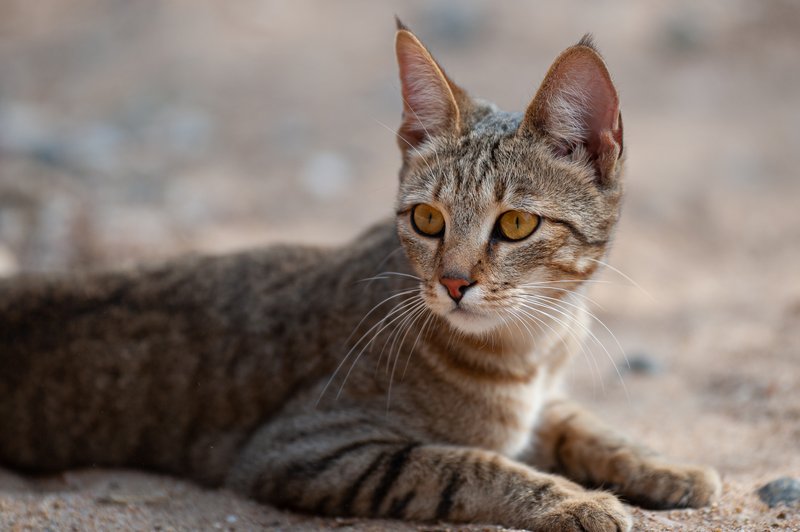
Domestic cats retain much of this wild behavior. While personality traits like sociability vary among individual cats, as a population, pet cats generally retain many of the same behavioral characteristics as their wild relatives.
This continuity between wild and domestic cats sets them apart from dogs’ relationship to wild wolves. Domestication dramatically distinguished dogs from wolves, behaviorally and sometimes quite drastically physically. Domestic cats, by comparison, have undergone fewer changes. Cats seem to have carved out a niche alongside humans largely on their own terms. When, how, and why this domestication happened mostly remains a mystery, one that community science can help solve.
As more cat owners participate in genetic research and more ancient cat DNA is uncovered, scientists will continue to piece together a clearer picture of cat evolution and domestication. Each sequenced genome adds resolution to the story and brings science closer to understanding how wildcats gradually became the cherished companions sharing our homes—and hearts—today.

