
Darwin's Cats
  • About us
    • Our story
    • Team
    • FAQs
    • Contact us
  • Our research
    • Darwin’s Cats
    • Darwin’s Dogs
    • Cat Ancestry
    • Data Sharing & Collaboration
  • DNA sequencing
    • Sequence your pet
    • Gift a kit
    • Register DNA kit
    • Instructions
      • Saliva kit instructions
      • Fur kit instructions
  • News
    • Blog
    • Press room
    • Pet of the month
  • Support our work
    • Donate
Laboratory
My Laboratory
Sign up/Log in
Darwin's Ark

About Us

Our storyTeamFAQsContact us

Our research

Darwin’s CatsDarwin’s Dogs

DNA sequencing

Sequence your petDNA kit registrationGift a kitSaliva kit instructionsFur kit instructions

News

BlogPress roomPet of the month

Support our work

Donate

Join the newsletter

Stay up to date with all of our projects and grow with us.

Follow us

Our partners

Board InstituteUMass Chan

Copyright 2026, Darwin’s Ark

Privacy policyTerms and conditions

Our stories

Blog Home

Blog Home

Debunking doggie DNA behavioral tests

By Claire HendershotNovember 26, 2025
behavior

Behavior

community-science

Community Science

dogs

Dogs

genetics

Genetics

A new study from Darwin’s Ark reveals that genetic tests claiming to predict dog behavior don’t hold up to scientific scrutiny.

Yellow Labrador Retriever tilts head to the left against a blue-grey background.

Can a DNA test really predict if your dog will be anxious, aggressive, or sociable? Genetic tests that claim to predict dog behavior—by analyzing only a small number of genes—are rising in popularity. However, results from a new study published by Darwin’s Ark scientists suggest that such claims are overhyped at best, and harmfully misleading at worst.

Published November 24, 2025 in PNAS, a National Academy of Sciences journal, the study tried to replicate results from earlier research that linked 151 genetic variants to dog behavior. However, after controlling for breed and considering each dog’s individual traits, the team found no evidence that any of these genetic variants truly predict behavior.

Instead, many of these falsely flagged behavioral genetic variants turned out to be strongly associated with physical traits like height and ear shape—the very things that distinguish dog breeds. The team concluded that earlier studies likely confused breed-related genetic markers for behaviorally predictive genes because they did not control for breed or consider how much dogs’ behavior can vary even within the same breed.

Inaccurate or oversimplified claims about behavioral genetics can have real consequences. Imagine if a shelter falsely labeled a dog as potentially aggressive or if a dog owner unnecessarily restricted their dog’s socialization due to fears stoked by an inaccurate DNA report. Previous research from Darwin’s Ark shows that dog behavior can vary as much within a breed as it does among breeds. That’s why it’s important that studies treat dogs as unique individuals and not just representatives of a breed.

Darwin’s Ark, and other similar community science projects, are taking a more scientifically rigorous approach to studying dog behavior. These projects explore the full complexity of dog behavior by analyzing genetic information and detailed survey data on thousands of dogs. The future of canine behavioral genetics is full of fascinating discoveries, but researchers can only unlock them through methods that can fully capture dogs’ scientific complexity.

Behavior isn’t one-size-fits-all

One of the most powerful tools for studying how DNA shapes behavior is something called a genome-wide association study, or GWAS. These studies compare whole-genome sequences with phenotypic data (observable traits like sociability or excitability) to find genetic variants associated with specific traits. Because GWAS rely on large, diverse datasets, they’re considered the gold standard in both human and animal genetics research. Darwin’s Ark uses this method in their own pet genetics research.

Related articles

A picture of Balto, one of Darwin's Dogs, walking toward the backyard in his backyard.

What’s next for Darwin’s Dogs?

Published on September 2, 2026

DNA sequencing is back, and the next chapter of discovery is just beginning.

Read more
The questions that unite pet owners

The questions that unite pet owners

Published on August 19, 2026

From ancestry to aging, the mysteries that fascinate pet owners are the same ones that scientists are working to answer.

Read more

But there’s a catch: GWAS require a lot of data. Accurate results hinge on recruiting thousands of participants, collecting detailed behavioral data on each dog, and sequencing high-quality genetic samples. Gathering all of this information takes time and resources, leading some researchers to seek out shortcuts.

One such shortcut is an approach known as a breed-average study. Instead of using phenotypic data from individual dogs, breed-average studies assign each dog the “average” behavioral profile of its breed.

For example, if owner-reported surveys indicate that the average Golden Retriever is generally observed to be friendly towards humans, a breed-average study assumes that all Golden Retrievers share that trait, regardless of how any individual Golden Retriever in the study actually behaves. Researchers then look for genetic patterns correlated with these averaged breed-level traits.

Breed-average studies can work well for studying simple traits closely tied to breed, like coat color or ear shape, but they fall short when applied to more complex traits like behavior or health conditions. Reducing individual variation to breed-level stereotypes oversimplifies the intricate interplay between genes and environment, and their combined effect on behavior.

Perhaps unsurprisingly, these two divergent methods—GWAS and breed-average studies—produce wildly different results. GWAS have identified only a small number of genes linked to behavioral traits, while breed-average studies claim to have found hundreds of such associations. So which method should dog lovers trust?

Genetic variants lose predictive power after accounting for breed, individual phenotypes

To answer that question, Darwin’s Ark researchers directly compared both methods using data from more than 3,000 dogs in the Darwin’s Dogs initiative.

From previous breed-average studies, the researchers selected 97 genetic variants linked to physical traits and 151 variants claimed to predict behavior. Then, they ran a GWAS on both sets of genetic variants, factoring in the unique behavioral profiles of each dog and controlling for breed.

Here’s what they found: the GWAS replicated 62% of the 97 genetic variants that breed-average studies previously linked to physical traits. It even uncovered 30 new associations between genes and aesthetic traits, demonstrating that the Darwin’s Dogs database is large enough to find genetic associations to highly heritable traits.

However, none of the 151 previously reported “behavior variants” could be replicated by GWAS. Once breed was controlled for and individual phenotypes were accounted for, those supposed links between genes and behavior disappeared. Furthermore, none of these 151 genetic variants even overlapped with regions of the dog genome known to be associated with behavioral traits.

Interestingly, some of these previously purported “behavior genetic variants” showed strong links to aesthetic traits. In fact, 17 of these genetic variants overlapped genomic regions associated with coat color, ear shape, and height, among other breed-defining physical characteristics. This suggests that breed-average studies may have mistakenly flagged physical trait breed markers as behavior predictors.

Darwin’s Ark personality profiles consider the behavior of thousands of dogs

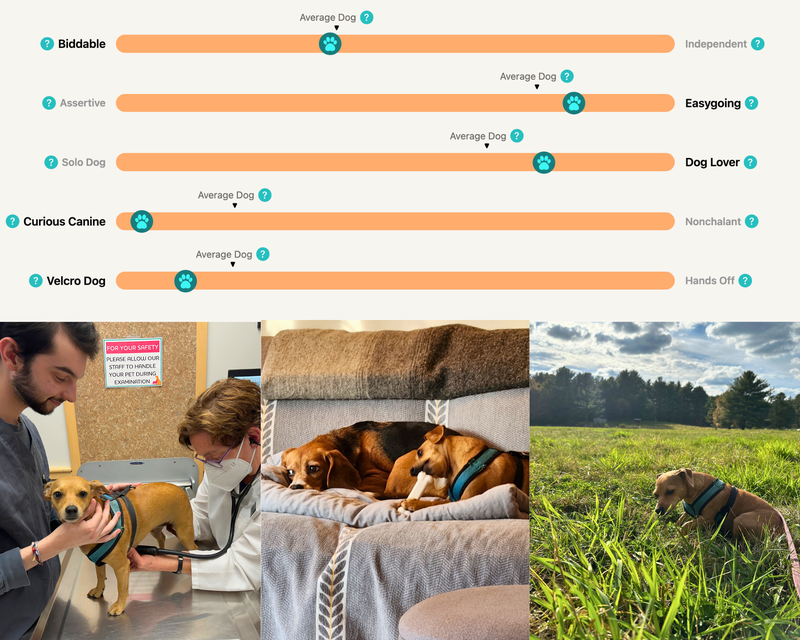
When scientists analyze behavioral data from large numbers of dogs, patterns emerge that reveal the true range of canine behavior, which often challenge long-held assumptions about what certain breeds are “supposed” to be like. For example, take Órla, a charming Chihuahua-Daschund mix and Darwin’s Ark participant. Both Chihuahuas and Daschunds are commonly stereotyped as quick to assert themselves when threatened, disinterested in other dogs, and subpar adventure buddies. Órla’s behavior tells quite a different story: she’s unbothered during stressful situations like vet visits, loves socializing with her many doggie friends, and relishes exploring the great outdoors.

Órla is…Easygoing and unbothered during her vet visit, a Dog Lover who likes to enjoy a snack alongside friends, and a Curious Canine who loves exploring anything and everything during outdoor romps.

Órla is one of many dogs whose behavior differs from the observed “average” behavior of breeds in her ancestry. Studies that only incorporate breed-averaged behavioral phenotypes—and fail to consider the many individual phenotypes used to calculate that average—disregard nuance and miss opportunities to explore genetic drivers of behavioral idiosyncrasies. Why is Órla so easygoing and sociable, despite breed ancestry stereotypes that suggest she’s prone to behaving differently? A breed-average approach could never answer that question accurately, and would instead conflate genetic associations to a breed’s small body size or short legs with genetic connections to an individual dog’s fearful or aggressive behavior. Instead, research that looks at the individual phenotypes of thousands of dogs can begin to explore genetic and environmental connections to behavior.

Looking ahead: methodology matters

The future of canine behavioral genetics lies in rigorous, large-scale studies that go beyond breed stereotypes and focus on individual dogs—their genetics, behaviors, environments, and life experiences. Initiatives like Dog10K are sequencing thousands of dogs, and community science projects like Darwin’s Ark and the Dog Aging Project are powered by thousands of pet owners contributing detailed data about their dogs’ health, habits, and behavior. These community science efforts are laying the groundwork for a deeper understanding of what shapes dog behavior.

Community science is reshaping what’s possible in behavioral genetics research. By making it more feasible to collect phenotypic data at scale—often the pinch point in conducting GWAS—researchers can ask and answer more complex questions. Scientific progress doesn’t come from shortcuts, but from careful observation and collaboration. With the participation of dedicated dog owners, science can move beyond methodological shortcuts and begin to uncover the true genetic and environmental foundations of dog behavior.


References

  1. K.A. Lord, V. Sohrab, K. Bryc, M.E. White, B. Kenney, K. Morrill Pirovich, F.L. Chen, & E.K. Karlsson, Genetic testing predicts appearance but not behavior in dogs, Proc. Natl. Acad. Sci. Online November 24, 2025. DOI: 10.1073/pnas.2421752122 (2025).
  2. Kathleen Morrill et al. Ancestry-inclusive dog genomics challenges popular breed stereotypes.Science. Online April 29, 2022. DOI:10.1126/science.abk0639