


You’ve just collected a sample of your cat’s fur and sent it to Darwin’s Ark’s lab for sequencing. But where does it go after that?
Once you mail back your cat’s sample, our team gets to work unlocking the unique story embedded in your cat’s DNA. Your cat’s sample travels on a transformative journey from fur to extracted DNA to sequenced genetic data that will power new discoveries.
Think of your cat’s genome—their full collection of DNA—as a book written in the four-letter code of nucleotides (A, T, C, G). Within that code lies a blueprint to your cat’s ancestry, traits, health, and genetic diversity. Sequencing many cats allows scientists to read and analyze a whole library of genetic “books” in order to explore big questions: How are populations of cats connected? Which genes influence specific traits? How did domestic cats evolve from wildcats?
When you participate in Darwin’s Cats’ sequencing research, our scientists read your cat’s genetic story letter by letter, helping advance scientific understanding of cat ancestry, traits, and health. Let’s take a behind-the-scenes peek at the intrepid journey that your cat’s DNA undergoes as it transforms from fur to findings.

Herding cats: It’s easy to herd 192 cats when they’re reduced to fur samples in a neatly labeled tube rack.
DNA extraction and sequencing prep
Once your cat’s sample arrives at our sequencing lab, the first order of business is to get the DNA out of the fur. To do this, each fur sample is submerged in an enzymatic solution that acts as a microscopic demolition crew, breaking down the structure of your cat’s hair and releasing its genetic material.
Now your cat’s DNA is free, but it’s swimming in a soup of cellular debris. To separate trash from genetic treasure, scientists use a clever trick: they add millions of tiny magnetic beads to the mixture. The DNA and the beads both carry negative charges, so they repel each other under normal conditions. However, their interaction can be controlled by adjusting the amount of salt in the solution. When salt concentration is high, sodium ions shield the negative charges and allow DNA to stick to the beads through hydrogen bonds. A strong magnet then pulls the DNA-covered beads to the side of the tube to separate the DNA from the rest of the solution. After a few washes, the salt concentration drops, releasing the purified DNA from the beads where it can be collected in a clean solution.

However, your cat’s DNA isn’t ready for sequencing just yet. A few additional steps are needed to modify the DNA into a format that the sequencer can recognize and read.
First, lab technicians add biological agents that cut the DNA strands into many smaller pieces. That’s because sequencing machines can’t read an entire genome all in one go. Just like a scanner can only capture one page at a time, sequencers can have technical limits to how much DNA they can read at once. If the genome is a book, this step divides the book into individual pages small enough for the sequencer to read.
A few additional modifications make this genetic confetti compatible with the sequencer. Among the most important is tagging each fragment with a short segment of artificial DNA called an index. This index acts as a molecular barcode unique to your cat’s DNA fragments. That’s because we don’t sequence your cat’s DNA alone—it’s simultaneously sequenced with up to 191 other cats! Indexes allow computers to sort the data later and match every sequenced fragment back to the cat it came from.
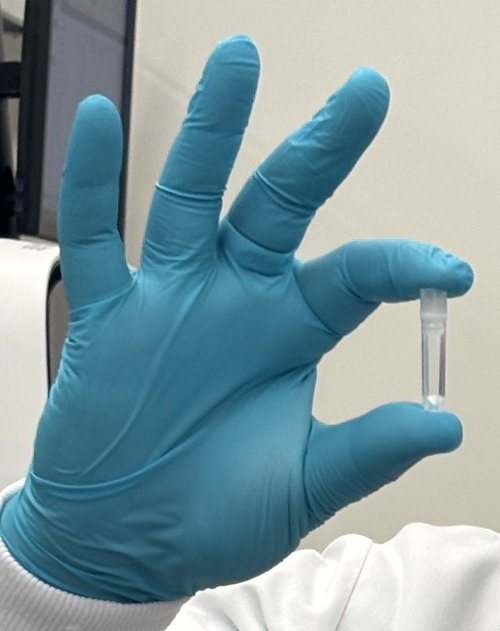
Once your cat’s DNA has been cut, prepared, and labeled, it’s pooled with samples from 191 fellow Darwin’s Cats and loaded into the sequencing machine, where its genetic story will be read letter by letter.
Whole-genome sequencing
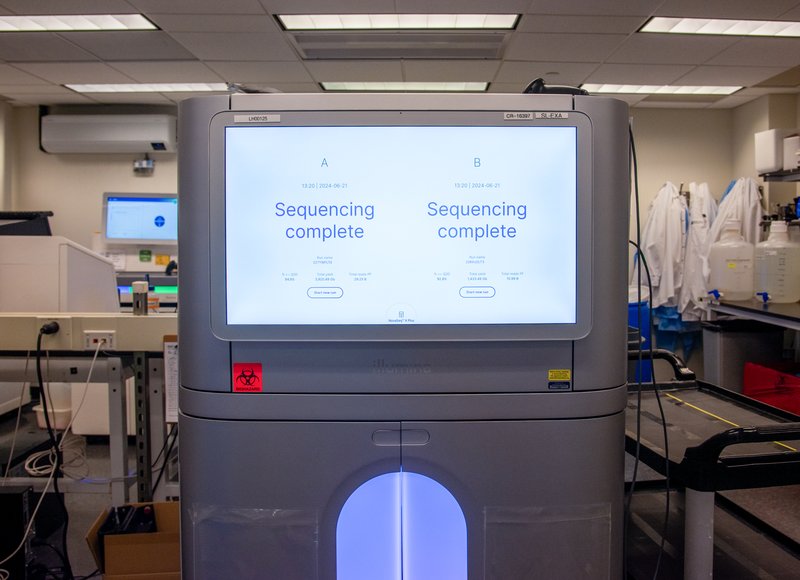
The pooled DNA from 192 cats is placed onto a small glass slide and loaded into the sequencing machine. Inside the instrument, each DNA fragment anchors itself to the slide and is copied thousands of times. This amplifies the DNA’s signal and makes it easier for the machine to detect. By the time this step is complete, there are more than one billion pieces of DNA clustered across the slide!
At last, sequencing begins.
Inside the sequencer, each of DNA’s four nucleotides—A, T, C, and G—is tagged with a fluorescent marker that glows a distinct color under laser light. One nucleotide might glow blue, another green, another red. As the sequencer reads each nucleotide one at a time, a camera captures each resulting flash of color. Those photos are exported to a computer that converts image data into text data representing the strings of nucleotides in your cat’s genome.
Over the course of roughly one day, a sequencer reads and records hundreds of millions to billions of DNA fragments. The end result is a massive volume of raw sequencing data.
Initially, this data is a chaotic heap of genetic confetti from 192 cats. This is where those molecular barcodes restore order: bioinformatic software uses each cat’s unique index to sort each fragment back to the correct cat. It’s like taking a pile of shredded pages and returning every confetti piece to the right book.
With the lab work complete, scientists now turn to powerful computational tools to piece together your cat’s genetic story.
Putting the genome together
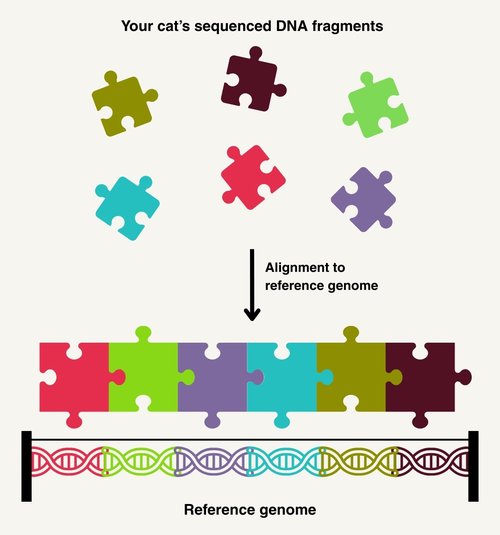
At this point, every DNA fragment has been attributed to the correct cat—but the pieces still need to be assembled in the correct order.
To do that, scientists compare your cat’s sequenced DNA fragments to a reference genome. The reference genome is a highly comprehensive DNA sequence from one thoroughly studied cat that serves as a template for analyzing other cat genomes. By aligning your cat’s DNA segments along the reference genome, your cat’s genetic book begins to take shape piece by piece. It’s a bit like assembling a puzzle using the picture on the box as a guide.
However, there are some missing pages in your cat’s genetic story. That’s because our sequencing method aims to read each DNA fragment about once on average. In practice, that means that some fragments are captured more than once, and some aren’t captured at all.
To fill those gaps, scientists use a powerful statistical technique called imputation that compares your cat’s genetic data to high-quality genomic data from many other cats. Imputation panels use population-level patterns to make informed predictions about missing data points on the individual level.
What makes your cat unique?
Once your cat’s genome is assembled, our scientists scan for differences between your cat’s DNA and the reference genome. These differences are called genetic variants. If the reference genome is the standard edition of a cat's genetic book, variants are places where your cat’s copy uses different wording. For example, the reference genome may include a genetic variant responsible for green eyes, while your cat’s genetic instructions yield blue eyes.

Genetic variants are what make your cat unique. Often, they can help explain differences in traits among individuals, from physical characteristics to health risks. Across the Darwin’s Cats community, researchers have already identified more than 100 million variant sites in the feline genome. Each newly sequenced cat adds more detail to this genomic map.
Quality check
Before your cat’s data enters the research pipeline for GWAS (genome-wide association studies) or other analyses that probe for correlations between genes and traits, our scientists perform a final quality control assessment. This step checks the quantity and quality of your cat’s sequencing data to ensure it meets the standards required for our scientists to interpret your cat’s genetic story with confidence. If the sequencing data meets established quality assurance levels, the data moves on to the analysis phase.
However, if there isn’t enough high-quality DNA data, we hit pause on this process. In some cases, we can sequence more DNA from the original sample provided. Other times, we may need your help to collect a new fur sample.
The good news is that most samples pass this quality control step. That said, DNA sequencing isn’t a perfect science. A quality control failure doesn’t necessarily mean there was a problem with your cat’s sample or with the sequencing process, but it does mean that we need to try again to collect your cat’s sequencing data before moving forward with research.
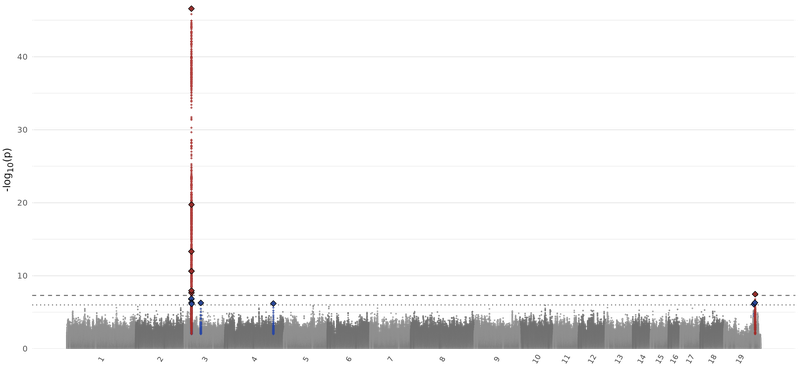
Aesthetic characteristics like fur texture, pattern, and color are strongly influenced by genetics, and Darwin’s Cats’ sequencing research confirms these traits are highly heritable.
This “Manhattan plot,” named after its resemblance to a city skyline, displays results of a genome-wide association study, or GWAS, among Darwin’s Cats. Using 334 Darwin’s Cats with a tabby fur pattern and 293 Darwin’s Cats without a tabby pattern (as reported by their owners in Darwin’s Cats surveys), our scientists tested for association between each cat’s genetics and tabby coat pattern. Along the x-axis are genetic variants ordered by their positions on chromosomes 1-19. The y-axis shows the strength of the genetic signal.
The results confirm the causal link between tabby fur pattern and a mutation in ASIP, a gene that regulates switching between producing two different pigments, creating the banded look of tabby cats.
Ready for research
What an adventure! Your cat’s genetic journey began as a few loose strands of fur and ended as a sequenced genome carrying valuable information that can translate into scientific discovery. This transformation is only possible because of an extraordinary collaboration among community scientists, molecular biologists, genetic sequencing experts, and computational biologists, all working together.
Human genetics has benefitted from decades of intensive research to refine and standardize the methods used to interpret the human genome. In cats, we’re still building that foundation. The feline genome has been far less studied, which means while every sample can pose new challenges, it also advances understanding of feline genetics, biology, and health.
Every newly sequenced cat strengthens and expands Darwin’s Cats’ genetic library. The more cats we study, the more power science has to explore the mysteries of feline biology and health: the genes behind coat patterns, cats’ evolutionary history, the genetic roots of complex traits, and so much more.
Somewhere in that growing library of genomes is your cat’s story, waiting to be read.

