


Update as of January 21, 2026: Enrollment for this study has closed. Thank you to all of our community scientists who expressed interest in participating!
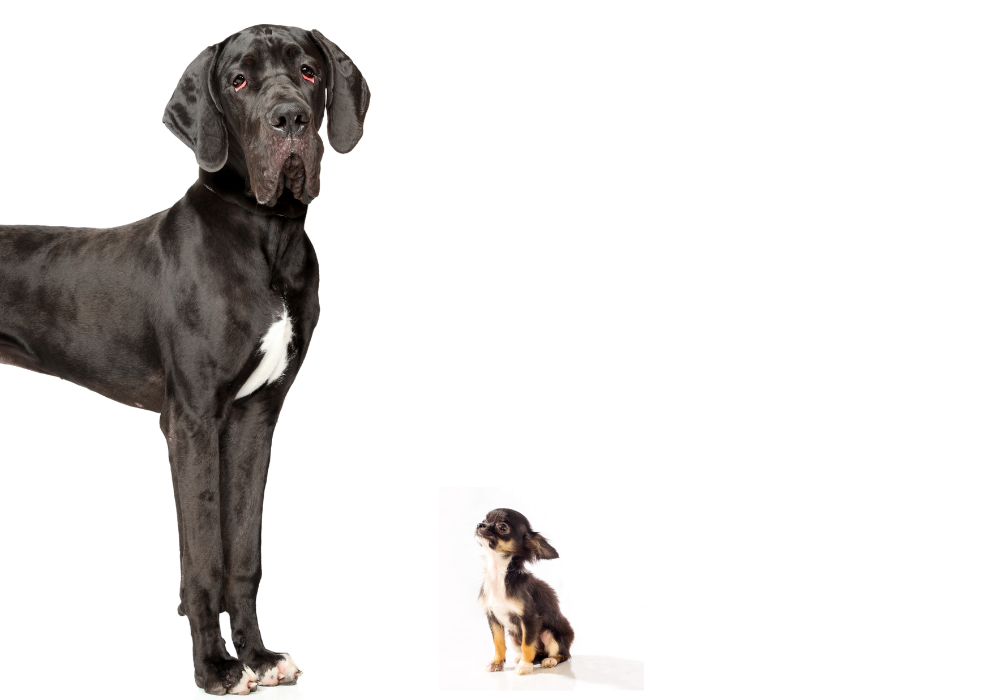
From pint-size Pomeranians to massive Mastiffs, dogs show greater variation in body size than any other land-dwelling animal. This incredible range is one of the clearest examples of how humans have shaped dogs through selective breeding. Although modern dog breeds have existed for more than 200 years, scientists have a limited understanding of how genes influence a dog’s body size, particularly at the smallest and largest extremes.
Previous research has identified several genes associated with dog body size. These studies typically relied on a type of sequencing technology called short-read whole-genome sequencing. This technique reads DNA in small pieces, and can miss more complex genetic variants that often can only be seen when looking at longer stretches of DNA. More recently, sequencing technology has made great advancements. A newer technique called long-read whole-genome sequencing can read larger sections of DNA, revealing more complex genetic variants.
Now, Darwin’s Ark affiliate scientists at UMass Chan Medical School and the Broad Institute of MIT and Harvard are using this advanced sequencing technology to build on science’s understanding of the genetic drivers of body size in dogs. They’re currently recruiting dogs that are very small (<10 pounds) or very large (> 90 pounds). The study is also looking for dogs of all sizes that were born outside the United States. By using the latest advancements in sequencing to study dogs with extreme body size, scientists hope to discover the genetic and evolutionary drivers behind why some dogs are pocket-sized while others grow to giant proportions.
The long and short of whole genome sequencing
Recent advancements in DNA sequencing technology have dramatically improved how accurately and deeply scientists can study genetic material. One important breakthrough in this space is long-read sequencing.
Unlike short-read sequencing, which reads DNA in many small fragments, long-read sequencing can read very large sections of DNA at once. This gives scientists a clearer picture of how different parts of the genome are arranged and how genes may interact with one another.
Long-read sequencing can also detect more complex mutations, like when pieces of genetic material are inserted, deleted, rearranged, or repeated. These kinds of mutations are often missed by short-read sequencing because it can’t read enough DNA at once to detect complex structural changes.
Through this new study, Darwin’s Ark affiliate scientists are using long-read sequencing to explore how genetics drives extreme dog sizes. Earlier studies have identified genes that are associated with body size, but long-read sequencing can help confirm whether those genes actually cause a dog to be large or small.
The study is also recruiting dogs of all sizes that were born outside of the United States. By including international dogs in the study, researchers are ensuring they capture genetic variants that might not appear in popular U.S. breeds. The more diverse the data, the more complete the picture of what truly drives the incredible range of dog sizes.