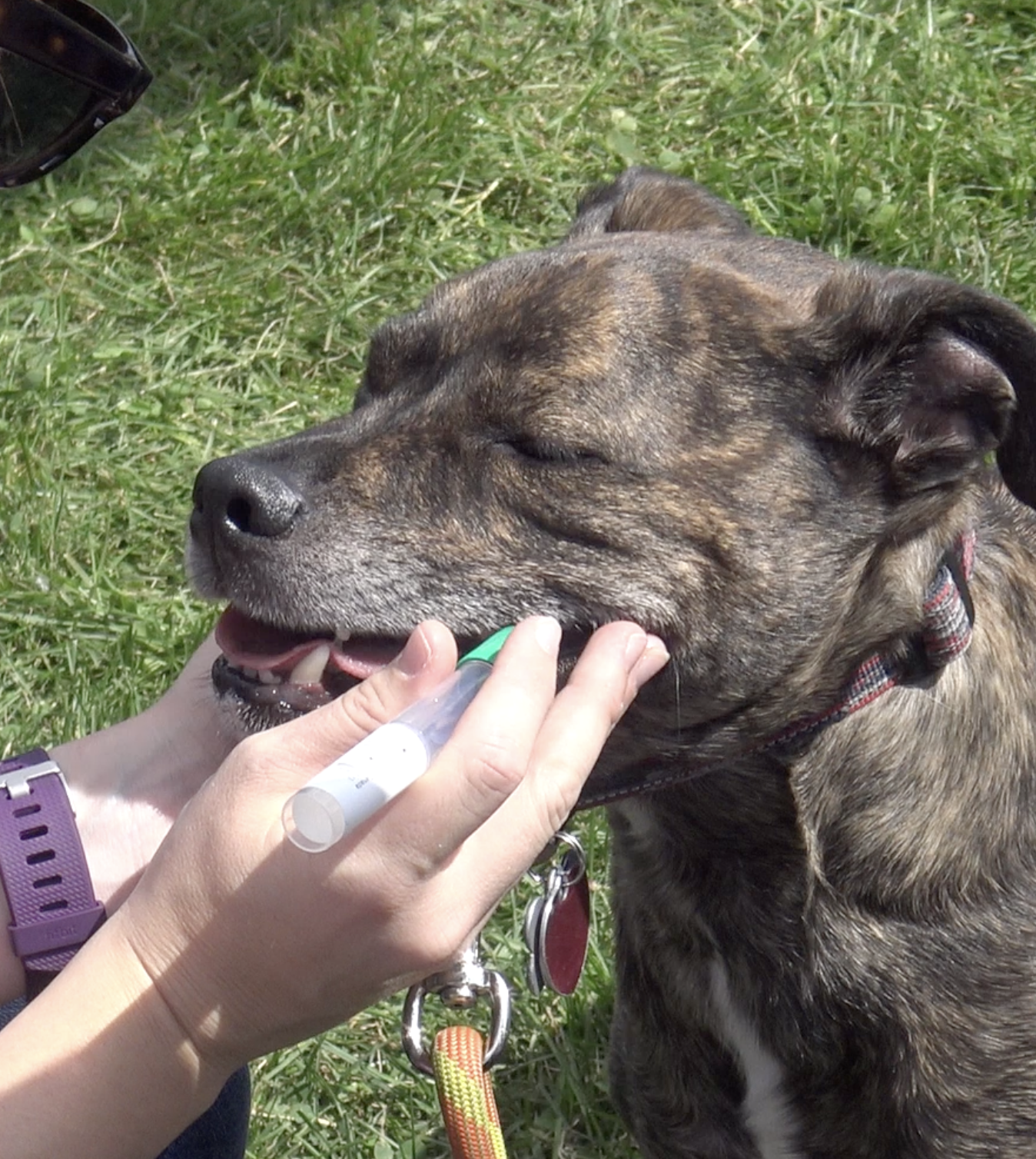


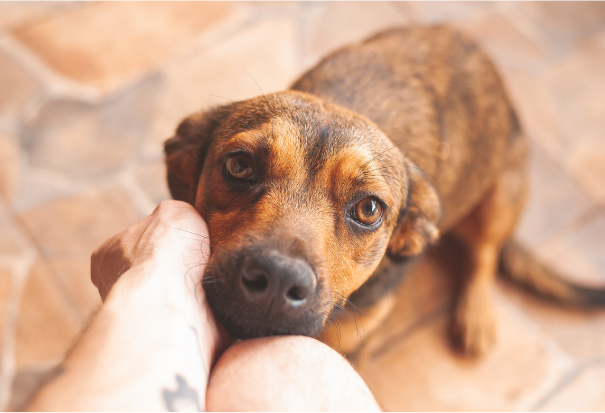
When you hear the word “domestication,” chances are you picture a dog—loyal and lovable, maybe snoozing on the couch or begging for table scraps. Dogs were among the first animals to be domesticated, but they’re far from the only ones. From animals like chickens and camels, to plants like wheat and rice, to microbes like lactic acid bacteria, hundreds of species have adapted, in one way or another, to thrive alongside humans.
Yet despite how familiar the concept seems, scientists don’t agree on what exactly “domestication” means. Some definitions focus on human control over another species, like animal breeding or crop cultivation. Other definitions rely on genetic or archeological comparisons to a population’s wild ancestors. This lack of clarity makes it difficult for scientists to study how domesticated species evolve to survive and thrive in the world around them.
To help cut through the confusion, Darwin’s Ark scientists Kathryn Lord and Elinor Karlsson teamed up with researchers from the University of Oxford and the University of Warwick to present a fresh definition of domestication. In a new PNAS perspective article, they propose that domestication is an evolutionary process in which a nonhuman population adapts to live in a human-created environment. This definition shifts the focus of domestication from human control to human connection, and encourages curiosity about how and why some species adapt to human environments, while others struggle to survive.
Domestic populations rely on human-created environments for survival
It’s a common misconception that domestic species live under direct human influence. In reality, most domestic species have entire populations that aren’t under human control at all. Many agricultural crops, including blackberries, barley, and alfalfa, are also prolific weeds that can grow to the point of causing economic or ecological damage. Many familiar domestic animals—like dogs, cats, horses, and pigs—have large populations that thrive outside of human influence. In fact, about 80% of the world’s dog population are free-roaming village dogs. These dogs live in loose association with people and rely on human-made environments to survive, but unlike pet dogs, village dogs aren’t directly raised by any specific individual or household. Even so, village dogs are fully domesticated because they rely on human-shaped environments and aren’t found outside of them.
So if human control isn’t a defining factor of domestication, then what is?
According to Lord, Karlsson, and their colleagues, domestication is best understood as a nonhuman population’s evolutionary response to human-created environments. Domestic populations aren’t necessarily tamed or trained, but rather adapted to thrive in new settings that exist because of human activity.
By that definition, your couch-loving, table-scrap-seeking pet dog is solidly domestic. So are scrappy village dogs, surviving on the easy access to food and shelter afforded by human-modified environments. But what about other canids like coyotes and wolves? According to the researchers, all animal, plant, and microbial populations can be placed on a spectrum from wild to domestic based on how heavily they depend on human environments to survive.
From wolf to “woof!”, canines span the domestication spectrum
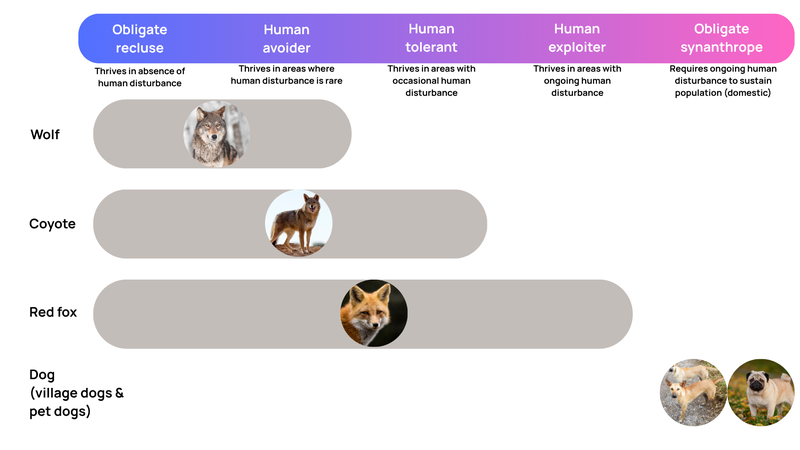
To better describe the range of relationships between human environments and nonhuman populations, the researchers devised a five-point domestication spectrum. Instead of drawing a hard line between wild and domestic, this model recognizes that populations can fall along a continuum based on their level of reliance on human disturbance.
One species can have multiple populations that occupy different points on this spectrum. For example, wild rabbits and pet rabbits belong to the same species, yet one population thrives outside of human influence while the other needs human-made environments to survive.
The same is true for canines. Dogs and wolves are subspecies, yet they represent opposite ends of the domestication spectrum. Zoom out to the canid family—a taxonomic group that includes wolves, coyotes, foxes, jackals, and other similar species—and we see a wide range of lifestyles shaped by varying degrees of reliance on human environments.
Let’s take a walk through the article’s proposed domestication spectrum using canine species as examples:
- Obligate recluses (wild populations) avoid human contact and thrive in remote wilderness. As human development spreads across the globe, truly wild populations are becoming increasingly rare. Some wolf populations, like wolves in the remote Canadian north, are obligate recluses.
- Human avoiders thrive in areas with infrequent human activity. They may live on the fringes of human-made environments, but steer clear of direct interaction. Some wolf populations are human avoiders.
- Human tolerators live near humans but only emerge when humans are less active, often at night. Coyotes are examples of human tolerators.
- Human exploiters are opportunists that make the most of the resources in human environments but don’t depend on them entirely. If the human-made environment suddenly disappeared, they would be just fine. Red foxes are human exploiters.
- Obligate synanthropes (domesticates) are fully adapted to life in human-altered environments. Both household and village dogs have evolved to the point where they would struggle to find food, avoid predators, and otherwise survive without human-modified environments.
Understanding where a species or population falls on the domestication spectrum can help scientists predict how they will respond to challenges like habitat loss, captivity, or climate change. It also helps identify populations that may be at risk of endangerment or extinction.
For dog lovers, this domestication spectrum brings new perspective to dogs’ origin story: domestication isn’t something that humans did to dogs, but rather something that dogs did with humans. Over thousands of years, dogs adapted to thrive alongside humans and formed one of the most enduring partnerships in evolutionary history.
So the next time your dog begs for table scraps or you hear a coyote howling into the night, remember that they’re both part of a remarkable evolutionary journey to survive in an ever-changing world. Their story is less about obedience or control, and more about resilience and adaptation to life in human-altered environments.