


February 11 marks International Day of Women and Girls in Science, an annual celebration of the women who ask bold questions, challenge assumptions, and expand what we know about the world. At Darwin’s Ark, a nonprofit founded and powered by leading women scientists, advocating for equal gender participation in STEM is an important part of our story.
To celebrate Women & Girls in Science Day, we’re launching a special Q&A series featuring a few of the women driving Darwin’s Ark’s groundbreaking research. Kicking off our Q&A series is Dr. Kathryn Lord, a canid research specialist at UMass Chan Medical School and the Broad Institute. Kathryn studies how animals’ environments shape their behaviors, and how those behaviors can evolve over generations. Her career began with hands-on work improving kennel design and enrichment for rearing working dogs and housing shelter dogs, but soon grew into a deeper fascination with canine evolution, a field that she delved into during her graduate studies in organismic and evolutionary biology. Currently, her research focuses on the genetic roots of developmental differences between dogs and wolves.
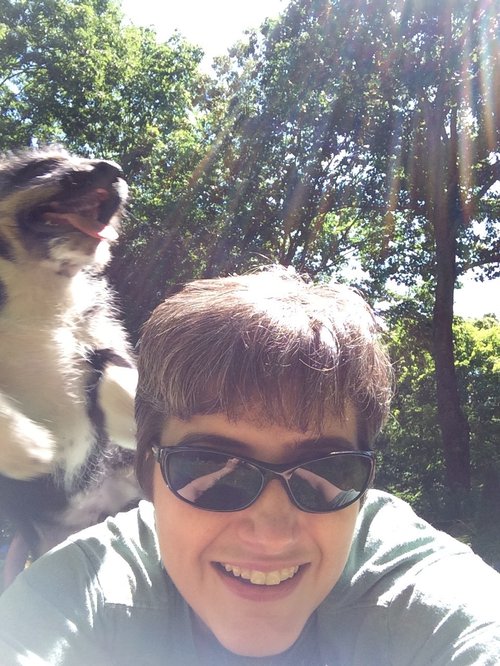
We spoke with Kathryn about what sparked her interest in animal behavior, how studying dogs can teach us surprising lessons about other species (including humans), and her advice for women considering a career in science. Along the way, you’ll find some action shots of Kathryn working with her canine research partners, proof that some of the most rewarding scientific career paths are driven by curiosity rather than convention.
What first sparked your interest in animal behavior and how it evolves over time?
I was interested in animals from a very young age. I grew up with a cat who was 25 pounds. He wasn't overweight, just huge. I was enamored of him and after he gave up on my older brother, he started to bring me small living mammals and birds like I was a kitten. I took care of his offerings overnight and brought them to a nearby Audubon center for rehabilitation. Overall, I was a complete disappointment in the hunting department.
My grandmother was also a nature lover and imparted that love of animals to me. I was drawn to the sciences from an early age, largely because that was how I could learn more about animals.
By the time I got to college, I thought I wanted to do marine biology, but after my first animal behavior class with Dr. Raymond Coppinger at Hampshire College, I was hooked.
Your research focuses on developmental and behavioral differences between dogs and wolves. What makes this comparison such a powerful way to study behavior and evolution?
Dogs and wolves are very similar genetically. They can reproduce and have fertile offspring, which means that under some definitions, they are members of the same species. However, dogs and wolves have evolved very different behaviors to survive in very different environments. For example, wolves have evolved to hunt large hoofed mammals, while dogs have evolved to survive as scavengers off of human waste. These behavioral differences emerged relatively rapidly and with only minor genetic changes. We hypothesize that these small genetic changes may have big impacts on an animal’s early development, which ultimately has a ripple effect on their behavior as an adult—this is what my research explores.
You began your work with dogs through efforts to improve kennel design and enrichment. How did those applied questions lead you toward broader evolutionary research?
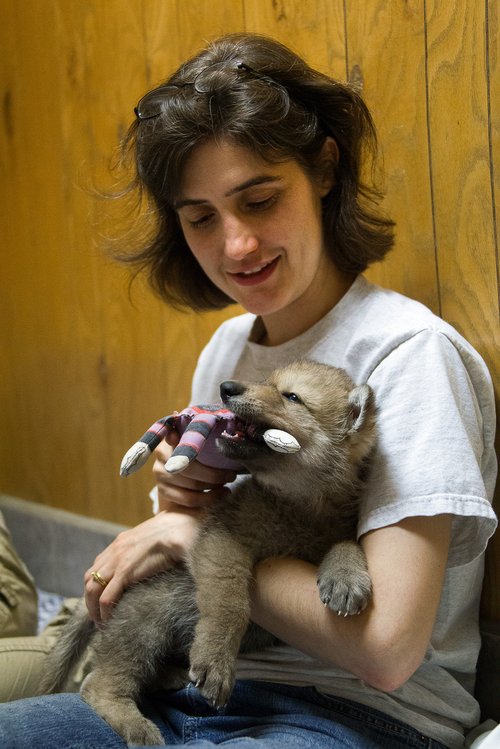
Even early in my career, I was interested in how genes and the environment interact to produce behaviors that allow animals to survive. I was particularly interested in a developmental period called the primary critical period of socialization. Early experiences during this time have significant and long-lasting impacts on adult behavior. The information that the animal takes in through its senses actually determines how their brain grows!
So, I was working on designing environments that allow kennel-raised dogs to develop behaviors needed to succeed in jobs requiring them to thrive in much more complex environments. I noticed that not all dogs respond to the same types of enrichment, or respond to enrichment in the same way. I realized that I needed to understand not just how environment affects behavior, but how genes and environment interact to influence behavior.
A lot of important behaviors take shape during early development. It has long been thought that differences in the timing of the primary critical period of socialization could explain many of the behavioral differences between dogs and wolves. I find it fascinating that behavior shaped by an animal’s environment could, over generations, evolve due to changes in genes.
For example, a dog’s fearfulness of new things depends heavily on its early experiences. The same is true of wolves, yet even when wolves are raised in the same environment as dogs, they tend to remain more fearful than dogs. I believe that understanding how these behaviors evolve is key to unlocking the complex ways genes and environment interact to produce behavior.
How do genetics and environment interact to shape behavior during development, based on what you’ve learned from your research?
That's the big question, isn't it! I suspect I may spend my whole life trying to figure this one out, and I hope my work will help us get closer to understanding it. But, we have some ideas.
We think that many behavioral differences between dogs and wolves come down to changes in the timing of the beginning and end of the primary critical period of socialization relative to the development of the senses. This change in timing would provide animals with very different experiences even in the same environment. For example, if wolves are blind and deaf for the first half of this period and only rely on their sense of smell, they would have a very different experience than a dog. Even if they have the exact same early environment, the wolf's brain would develop differently because it is taking in different sensory information over the course of this critical period than a dog in the same environment.
"I am constantly coming up with new questions. The more I learn and observe, the more I want to know—that is what is so great about science." - Dr. Kathryn Lord
What are you most curious about right now when it comes to understanding how behavior changes across generations?

I am constantly coming up with new questions. The more I learn and observe, the more I want to know—that is what is so great about science. I am still driven by that main question, "how does behavior evolve?" How does something that relies on the environment evolve over generations? How do genes and environment interact to produce behavior?
Some of the more specific questions I am working on include confirming the timing differences in the primary critical period of dogs and wolves, so we can identify the genetic mechanisms controlling this timing. I’m also investigating how changes in early development of hunting behavior might explain differences among working lines of dogs (hunting, herding, guarding dogs) as well as wolves. I would love to do work on the secondary critical period of socialization as well, which we call adolescence in humans. Just as with the primary critical period of socialization, the secondary period is another developmental timepoint where small changes in the timing of development could result in large behavioral changes.
How can studying dogs help us better understand behavior in other species, including humans?
All birds and mammals, including humans, have a primary (and secondary) critical period of socialization. If we can understand how this period has evolved in dogs, it is likely to give us great insight into how it works in other species, including humans. This could help us to not only improve welfare for animals in captivity, but also to better understand how different animal populations will or won't be able to recover from human disturbance. It could also help us understand human disorders that result from dysregulation of critical periods of development.
What has it been like working at the intersection of applied animal welfare and evolutionary biology?
I feel very lucky that I get to do exactly what I am interested in. It is a strange combination that got a lot of confused responses when I was starting out as a graduate student, but I am continually pleasantly surprised at how well the two things mesh. I was initially driven by a desire to improve the lives of animals and then by my own curiosity at how biology and evolution work, but as the famous quote by renowned geneticist Theodosius Dobzhansky goes, "Nothing in biology makes sense except in the light of evolution." I really think the key to leaps forward in science is the joining of different disciplines to answer pressing questions.
What advice would you give to girls or young women who are interested in science but aren’t sure where they fit yet?
Don't be afraid to explore, whether it be in reading books about different topics, going to talks by scientists open to the public, watching documentaries, or just looking and wondering about the world around you. Many famous and Nobel-winning scientists got their start by just looking carefully at the world around them and wondering, “why?”.
What does Women and Girls in Science Day mean to you personally?
I feel very lucky that I didn't really notice that there was an inequity in science until I got to the college level. I was always very encouraged as a child to follow my interests. I hope that we can reach a point where that is a reality for everyone up to and beyond the college level.
What advice do you have for young women considering a career in science?
First of all, yay! I think sometimes people may feel intimidated about science because it’s perceived as something only people with certain skillsets can do, say maybe people who self-identify as really good at math or don't fog up safety goggles. But science is really a very broad field, and most scientists don't spend their day holding up tubes of blue liquid or doing arithmetic in their heads.
Science is a process; it is a way of investigating the world. This means there are so many different things you can do as a scientist that require people who are good at lots of different things. I have found that everything once suggested to be a barrier to pursuing my current career has ultimately been a strength. If you are interested in science, don't talk yourself out of it based on your preconceptions about what it is to be a scientist. Follow your curiosity toward discovery instead.

