


Darwin’s Ark community scientist Jennifer doesn’t need an ancestry test to know where her cat, Fern, came from. Years ago, when Jennifer was stationed in Guam as an Army veterinarian, one of her clients received an unexpected visitor: a little kitten who had ambled into their backyard. The client passed the furball along to Jennifer, and the rest was history.
Jennifer may never know exactly where on the island Fern was born, but she's reasonably certain Fern is a Guam-born cat. After all, Guam is a Micronesian island surrounded by hundreds of miles of Pacific Ocean; it’s unlikely that Fern was born off the island.
However, Fern’s ancestry insights tell a different story.
Her ancestry report shows a smattering of North American regions, international regions, and breeds, none of which reflect what Jennifer knows about Fern’s origins. That’s because there are no Micronesian cats in Darwin’s Ark’s current cat ancestry reference panel, which was introduced in September 2026.

Fern’s anomalous ancestry estimates represent a greater challenge in genetic ancestry research: Ancestry estimates are only as accurate as the reference data behind them.
When a cat’s DNA doesn't closely match any of the populations in the reference panel, the algorithm still assigns ancestry to the closest available matches, even when those matches aren't particularly good.
Cats like Fern, who come from breeds or parts of the world not yet represented in our reference panel, belong to a small ancestry category that Darwin’s Ark calls Uncharted Territory. Currently, just 66 cats fall into this cohort, but their contributions to genetic research are anything but small. Their ancestry results can help scientists identify gaps in our reference panel and determine where more genetic data are needed.
Building a genetic map
To understand Uncharted Territory ancestry, we first need to understand how the Darwin’s Cats reference panel was built. We introduced the four ancestry categories in our September blog, but let's take a closer look at the science behind them.
Before Darwin’s Ark scientists had an ancestry reference panel, they had a question: Do cats from different parts of the world have different genetic signatures? In other words, can a cat’s DNA tell us what parts of the world their ancestors came from?
To find out, researchers analyzed genomic data from thousands of cats. Some data came from previously published genetic studies, while other data came from the first 1,000 sequenced Darwin’s Cats.
A significant pattern emerged: cats with similar genetics tended to have similar birth locations.
Cats born in the same geographic area tended to share more genetic similarities than cats born farther apart. These geographic clusters form the 13 distinct U.S. regions in the Darwin’s Cats ancestry reference panel. Breeds also form their own genetic clusters, independent of birthplace. For instance, a Maine Coon born in Brooklyn is more genetically similar to a Maine Coon born in Texas than their fellow NYC neighbors.
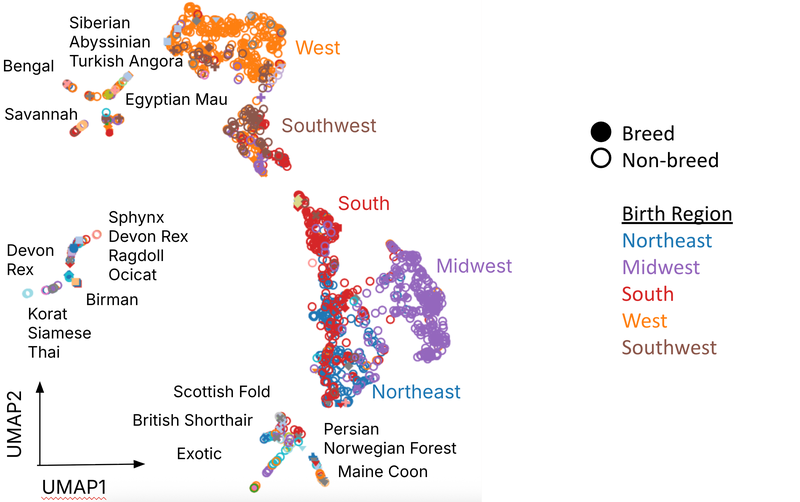
Altogether, the Darwin’s Cats ancestry reference panel represents 42 populations of cats from:
- 13 U.S. geographic regions
- Three broad international regions
- 21 breeds
- Five wild cat populations.
These populations serve as benchmarks for estimating ancestry, but they don't include every geographic region or breed. After your cat is sequenced, an algorithm compares your cat’s genetic patterns against those of the reference panel cats, then estimates the combination of reference populations that best match the patterns in your cat’s DNA.
If your cat’s true ancestry is well-represented in the reference panel, the algorithm identifies the population(s) that best match your own cat’s genetic background.
But for cats like Fern whose origins aren’t represented in the reference panel, the ancestry-estimating algorithm still has to work with the limited data available to it. While Uncharted Territory cats still receive ancestry estimates based on the reference populations with the closest genetic similarities, these estimates are likely considerably different from their true ancestry.
These cats’ unexpected ancestry insights tell us less about how unusual Uncharted Territory cats are and more about the limitations of the current reference panel. These cats help researchers recognize gaps in the reference panel, identify populations in need of greater study and build a more complete picture of feline genetic diversity.
There’s still plenty of work to do before we can better understand Uncharted Territory ancestry. That work starts with sequencing more cats. If your cat was born outside of the United States or has ancestry from a breed not yet represented in our reference panel, consider sequencing them with Darwin’s Ark. Your cat’s participation in open, community-powered research could help researchers uncover missing pieces of cats’ genetic history and help put Uncharted Territory cats on the genetic map.
In the meantime, let’s meet some of the cats repping Uncharted Territory. Their stories are a reminder of just how much there still is to discover about feline genetics.
What cats live in Uncharted Territory?
Many Uncharted Territory cats were born outside of the United States. Although the Darwin’s Cats reference panel includes three broad international regions, they only cover so much geographic ground and are represented by far fewer cats than the 13 U.S. regions.
Three international regions can’t capture the genetic diversity of cats around the world. Cats born throughout the Caribbean, South America, Subsaharan Africa, Australia, and much of Asia may also fall in Uncharted Territory.
But Uncharted Territory isn’t exclusively international. Some U.S.-born cats also fall outside of the geographic populations in our reference panel.
Take Loki, a cat born in northern New Mexico, where researchers don't yet have enough genetic data to fully understand the local cat population. His ancestry estimates include significant contributions from the Central U.S., Southwest and Gulf Coast, three nearby regions represented in our reference panel.
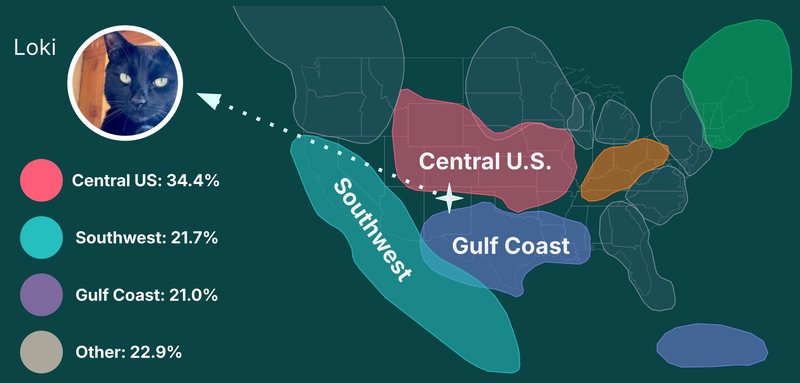
These results suggest that the algorithm is detecting real genetic similarities between Loki and cats from neighboring regions, even if those populations aren’t quite the best match for his ancestry.
Geography isn't the only reason a cat might land in Uncharted Territory. Some cats get there because their breed isn’t represented in our reference panel.
Take Pandu, a Balinese cat. Although Balinese cats are closely related to Siamese cats, they’re a distinct breed that isn’t yet included in our reference panel. As a result, Pandu’s ancestry estimates don’t directly identify his Balinese cat background. Instead, they show contributions from other breeds that share ancestry with Siamese cats and other cat breeds originally from Thailand.
Whether they were born halfway around the world, in a hidden corner of our own backyard, or descend from a rare breed, Uncharted Territory cats come from all walks of feline life. The more we learn about their background, the better we can understand all cats.
Your cat can help us put more Uncharted Territory cats on the genetic map. Consider sequencing your cat with Darwin’s Ark, especially if they were born internationally or have unusual breed ancestry. Learn more about joining our sequencing research, explore what we’ve discovered so far, and spread the word to cat-loving friends and family.

