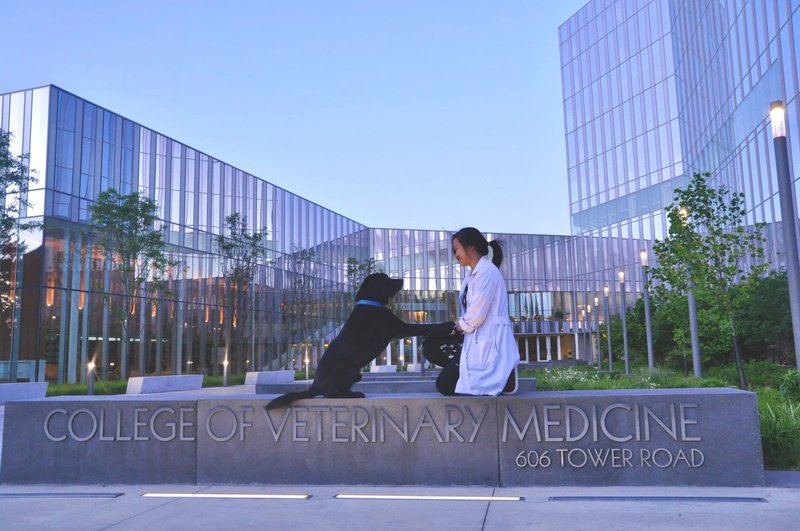
From sneaking out of anatomy lab to study Hox genes to raising 15 guide dog puppies, Dr. Frances Chen explains how canine genetics is the missing link in solving complex health challenges for both dogs and humans.
Last month, we kicked off a special Q&A series celebrating International Day of Women and Girls in Science, a global observance that promotes equal gender participation in STEM. Now, we’re closing out the series in Women’s History Month with one final installment featuring Darwin’s Ark scientist and working dog expert, Dr. Frances Chen.
Dr. Frances Chen, DVM, PhD is a veterinary scientist and assistant professor at University of Massachusetts Chan Medical School. Her research journey began not in a lab, but through hands-on work raising 15 guide and service dog puppies. That experience sparked a deeper curiosity: how do biology and genetics shape a dog’s health, behavior, and ability to serve in a working role? Her curiosity led her to pursue advanced training in both veterinary medicine and biomedical sciences.
Today, Dr. Chen works at the intersection of genetics, veterinary science, and translational medicine, where she studies dogs as powerful models that elucidate the genetic influences behind complex health conditions like cancer and age-associated diseases. She collaborates with academic and industry partners on developing genomic tools to improve health and well-being for companion animals, working dogs, and the humans that depend on them.
What inspired you to pursue a career as a veterinary scientist?
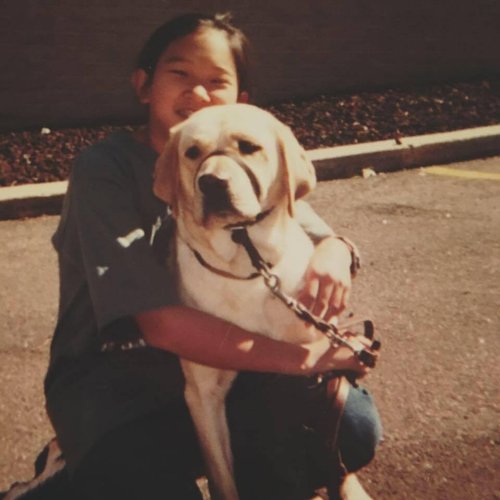
12-year-old emergent scientist Frances Chen with Donette, a yellow Labrador Retriever from Guide Dogs for the Blind. Donette was the second guide dog that Frances raised.
I decided to become a veterinarian at age 10, the same year I started raising my first guide dog puppy. Research had never been part of the plan, at least the one I had formed as a 10-year-old. That changed when I started veterinary school and found myself sneaking out of gross anatomy lab to attend a talk about Hox genes—the genes that shape vertebrate body plans and explain how differences in DNA allow an embryo to develop into something as distinct as a mouse or a snake.
That was when I first realized I had been “bitten” by that proverbial research bug—that moment of awe that instills in you the drive to discover. After that, I applied to my vet school’s combined DVM/PhD program. That set me on a path to apply both veterinary and research training to my career, no matter what role I found myself in—veterinarian, scientist, or something in between—to positively impact both humans and animals.
What is a veterinary scientist, and how does your job differ from that of a veterinarian who works in a clinic?
In most cases, a veterinary scientist is someone trained in both veterinary medicine (e.g., a DVM degree) and research (in my case, genetics and biomedical/translational research). Rather than focus on the clinical aspects of veterinary medicine, veterinary scientists can advance research anywhere along the spectrum from basic research to applied veterinary research.
My research focuses on diseases shared by both humans and animals. Improving understanding of the biology behind these shared diseases (like cancer and aging-associated diseases) opens the door to developing better medicine for both humans and animals. While the day-to-day of a veterinarian who works in a clinic usually involves diagnosing, managing, and treating individual patients, my day-to-day focuses on advancing research projects that deepen our understanding of how genetics influences health and disease. I focus on how new DNA sequencing technologies can be applied to improve human-animal welfare and performance, specifically in working dogs.
You’ve raised 15 guide and service dog puppies. How has that hands-on experience shaped the way you think about genetics, behavior, and health?
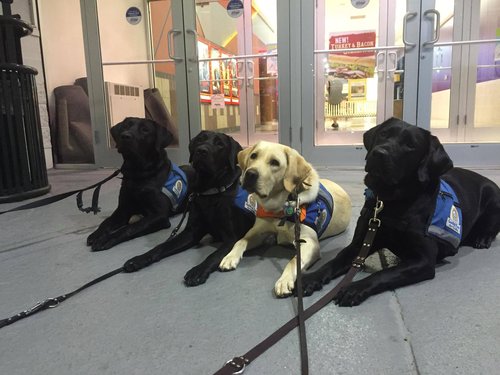
Four Labrador Retrievers don their service animal vests from Guiding Eyes for the Blind, a nonprofit that provides guide dogs for people with vision loss.
Fifteen sounds like a lot—though for a genomics researcher, that’s a sample size of approximately nothing! But in every other sense, those 15 puppies have been everything for me.
Joking aside, raising those puppies has been one of the most formative experiences of my life, both personally and scientifically. It's taught me how important it is to understand differences and similarities among individuals and the populations they come from. And it's driven home just how complex behavioral and health traits really are.
Being a longtime puppy raiser has shown me firsthand the power of mission-driven, community-based work—whether in the context of community science or in the collective effort required to raise and train guide and service dogs. It has been a genuine privilege to collaborate in my working dog genomics research with Guide Dogs for the Blind, Guiding Eyes for the Blind, and Canine Companions—the three organizations my 15 puppies came from. These communities bring a depth of care, knowledge, and commitment that, through collaboration, allows research discoveries to translate into real-world impact.
Each puppy I’ve raised is a reminder of why science matters, and a push to make sure my work can advance human health while also serving the dogs who serve us.
What distinguishes a working dog from a companion dog, and what unique insights can working dogs offer researchers that other animal populations can’t?
A working dog is any dog bred and/or trained for a job beyond companionship. These jobs range from agriculture and livestock work to guide and service roles, detection, search and rescue, or security and defense.
What makes working dog populations so scientifically valuable is the data. Working dog organizations—especially guide and service dog programs—often run large-scale breeding programs that produce anywhere from dozens to over a thousand puppies per year. That means researchers can access data on hundreds or thousands of dogs from the same population, tracked longitudinally from puppyhood through end of life.
The diversity of working dog roles also means there's a remarkable range of behaviors researchers can study and ask how genetics may or may not influence traits that matter enormously in the real world.
“Each puppy I’ve raised is a reminder of why science matters, and a push to make sure my work can advance human health while also serving the dogs who serve us.” - Dr. Frances Chen
How could better genomic tools directly improve the health, longevity, or training success of working dogs?
Applying genetics to improve animal health and performance isn't new—it's been happening in livestock breeding since the 1940s. But the tools have gotten dramatically more powerful over time. Together, researchers and breeders have incorporated the latest advancements in genomic technology to reduce unwanted traits like disease susceptibility and enhance desired ones like heat resistance, milk production, or fertility.
We’re now advancing on research projects to show that the same genomic tools can be applied to working dogs. Better genomic tools could help breeding programs select dogs more likely to be physically healthy and behaviorally well-suited for demanding roles. This could increase success rates, reduce economic burdens for nonprofit working dog organizations and most importantly, better serve working dogs and the humans who depend on them.
For pet owners who hear “genomics” and feel intimidated, how would you explain why this research matters for their own animals?
Genomics just refers to "reading" DNA sequences to better understand how DNA shapes health, disease, and behavior. DNA is the blueprint for all living things, so we can't fully understand biology, or apply that understanding to improve animal health and welfare, without knowing how genetics contributes to it.
With genomics, we can see how DNA sequences differ among individual dogs and explore what those differences mean for health, longevity, and quality of life. For pet owners, that translates into things like better diagnostics, more targeted treatments, and eventually, healthier animals from the start.
When scientists use dogs as models for complex disease, what does that mean in practice—and why is it so valuable for studying cancer and age-associated diseases?
In practice, it means there are enough biological similarities between dogs and humans in terms of how cancers develop, how the body ages, how the brain and metabolism change over time. Research in dogs is genuinely relevant to understanding and treating disease in people. But there are also key differences that make dogs uniquely useful.
One of the biggest differences that makes dogs a valuable disease model is that they age faster and have lifespans roughly seven to ten times shorter than humans. Cancers and age-associated diseases that can take decades to develop in a human can appear in a dog within just a few years. That compressed timeline means researchers can observe disease progression, test interventions, and gather data on health outcomes that would take a human lifetime to accumulate otherwise. This is a powerful and complementary approach to research that studies these diseases directly in people.
What makes studying conditions like cancer and age-associated diseases particularly challenging—and exciting—from a genetics perspective?
These are what we call "complex traits,” meaning they’re shaped by a mix of genetic factors and many varying environmental and lifestyle influences. Unlike simpler traits like coat color or certain inherited eye conditions, complex diseases are influenced by dozens, hundreds, or even thousands of small variations scattered across the billions of base pairs in the genome.
That complexity is exactly what makes them so challenging, but also so fascinating. There's no single gene to find and fix. Instead, we have to piece together a way more intricate puzzle, which requires new analytical tools, large datasets, and a lot of collaboration. When we start to understand the patterns, it opens up new possibilities for prevention and personalized care.
What are we beginning to learn from your work at Darwin’s Ark?
One of the most exciting findings so far is that certain cancers—like hemangiosarcoma, a cancer particularly common in some dog breeds—appear to have a strong genetic component, making them promising candidates for prevention through informed breeding strategies. That's really significant because it means genomics could potentially be used upstream, before disease ever develops, to reduce how often these cancers occur. We're still early in this work, but the initial signal is genuinely promising.
“There's no single gene to find and fix. Instead, we have to piece together a way more intricate puzzle, which requires new analytical tools, large datasets, and a lot of collaboration. When we start to understand the patterns, it opens up new possibilities for prevention and personalized care.” - Dr. Frances Chen
What have you learned along your journey in research that you want young women who are considering a research career to know?
Research requires being driven by curiosity, not just the (very valid!) desire to get things done. There has to be space, time, and patience to explore both what you know you don't know and what you don't yet know to ask. That openness is essential.
Impactful science is a team endeavor, so cultivating that curiosity-driven mindset depends on who you're surrounded by. Finding research environments, teams, and mentors that nurture exploration, not just execution, can make all the difference. Seek out the people and places that give you the safety and room to do so.
What else would you like others to know?
Everyone has a role to play in science—all you need is curiosity and a willingness to discover what we don’t yet know, or might even be wrong about! I couldn’t be more thrilled that we have opportunities with nonprofit organizations like Darwin’s Ark to engage with animal lovers in discovery and impact. Science isn't just something that happens in a lab or with people with a bunch of letters behind their name. It's something we can all contribute to.
Inspired by Dr. Chen’s work? You can contribute to the future of canine health by taking dogsurveys today. Your dog’s data helps scientists like Dr. Chen solve the puzzles of cancer, aging, and behavior for dogs and humans alike.