


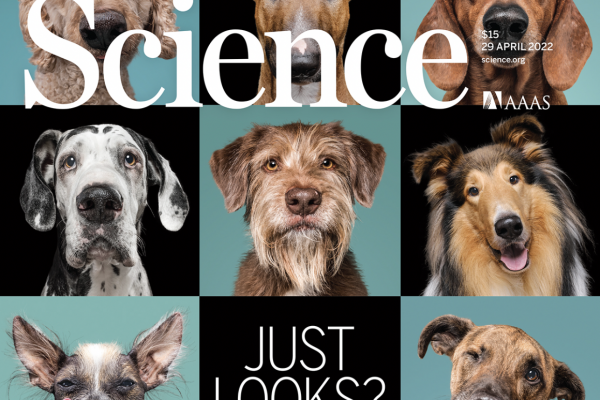
About eight years ago, my team and I headed down a rabbit hole of breed behavioral genetics. Today, with our major publication in the journal Science, we finally emerged. I want to say thank you, and tell the Darwin’s Ark community a bit more about what we found.
After researching the connections between dog genetics and dog behavior (work with important ramifications for human psychiatric disease research) for a while, we’d become increasingly concerned that much of our work relied on the premise that dog breeds had behavioral (not just physical) differences that could be traced back to their DNA.
It turned out that no one really knew for sure whether that premise is correct. Most studies focused on purebred dogs, who are just a small minority of all dogs. To test if breed dogs are different from other dogs, we needed to study all dogs (including mutts).
We launched Darwin’s Ark in 2015 and were quickly overwhelmed (both emotionally and logistically) by the interest of dog owners to support our work. Our vision for building an open data resource for pet research seemed to resonate with owners curious about their canine companions. No one had done anything like this before. We leveled up both scientifically and logistically, launching a new website and new system for enrolling. We argued at length with countless scientists, asserting that yes, we could ask people about their dog’s behavior and trust them to respond accurately. We tried to build the plane while flying it, relying on the support of all of our participants to realize a new vision for dog research.
It took us seven long years, and some trial and error, but with the participation of tens of thousands of dog owners, we got here. In today’s publication, we answer that deceptively simple question:
Do breeds really have distinctive behaviors and personalities?
The answer: not really – it turns out that breed really is, for the most part, just “skin deep”. There is so much variation in behavior and personality in every single dog breed, it’s impossible to accurately predict the behavior of any individual dog from its breed alone.
That’s not to say breed doesn’t matter at all. We do find some small behavioral differences in some breeds. For example, some breeds tend to be a bit more interested in playing with toys, or more eager to please. These differences can (sometimes) be traced back to the types of dogs used to start the breed, suggesting the behaviors are much older than the breeds. Dogs from breeds with herding ancestry tend to be a little more toy-directed, engaged, and biddable (ready to accept and follow instructions). Dogs from breeds with toy dog ancestry tend to be more independent and less social with other dogs.
The key strength of Darwin’s Ark turned out to be the genetic diversity of our dataset. We welcomed all dogs – purebred, mixed, and mystery dogs. One of the first things we did was develop a “breed-calling” algorithm that could tell us the breed ancestry of the mixed breed dogs. Breed calling is complicated: there isn’t anything one thing (or even a few things) in DNA that tells us a chihuahua is a chihuahua, or a great Dane a great Dane. We use hundreds of thousands of tiny changes (each one found in only some of the dogs in each breed) to tell them apart.

