



Have you ever wondered why some dogs chase toys, some shake toys until the stuffing comes out, and others stalk toys with eerie precision despite never having hunted a day in their lives? These play behaviors often seem instinctive, but where do they really come from? Are they learned, or hardwired into a dog’s DNA?
Some researchers hypothesize that dogs’ play behaviors are echoes of their evolutionary past, rooted in wolf hunting strategies. To test these ideas, scientists typically record lots of video footage of animals and then analyze it frame by frame. However, this video review process is time-consuming, and there’s far more footage than there are experts to analyze it. Now, researchers are curious to see if a community science approach could help overcome this obstacle.
Darwin’s Ark affiliate scientists in the Karlsson Lab at UMass Chan Medical School recently launched Pounce!, a community science project that invites dog lovers to watch short videos of puppies and tag certain behaviors when they appear. The project is currently in its pilot phase, testing whether the power of many volunteers can reliably identify patterns in how puppies play. If successful, Pounce! could shed new light on the evolutionary link between dogs and wolves, and even advance conservation research by helping build better research tools to study the behaviors of other species.
So much footage, so little time
Video technology has transformed how scientists study animal behavior. Cameras can capture important footage without interfering with animals, giving researchers more accurate data than ever before.
However, this advancement is both a blessing and a curse: there’s too much video data and too few data analysts. Sifting through all of that video data takes a lot of time, and right now, only a small number of trained experts are qualified to analyze something as complex and multidimensional as animal behavior. Automating this video coding process would require training AI models on lots of behavioral data, so human eyes are essential for video data analysis.
But what if instead of relying on a handful of experts, scientists could crowdsource help from hundreds of sharp-eyed dog lovers? That’s exactly what Pounce! is testing.
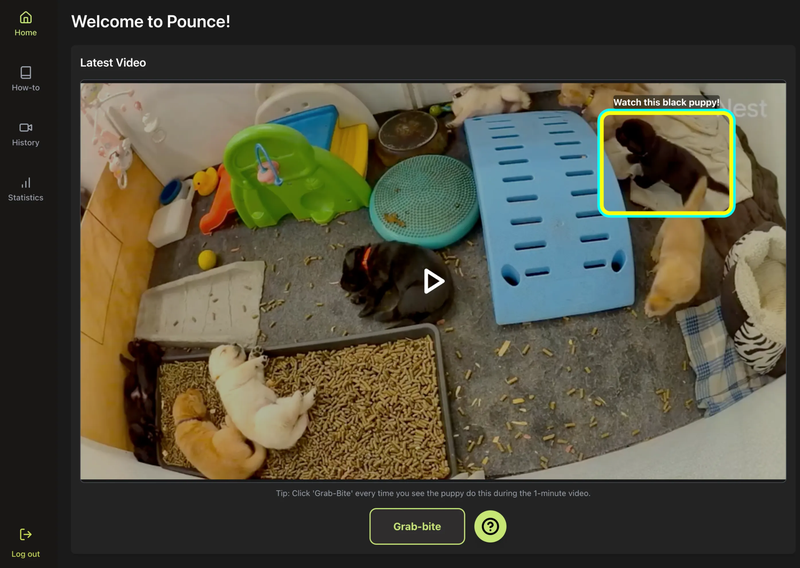
Pounce! invites dog lovers to join in the research by visiting its online portal. Once there, they are guided through a quick tutorial showing exactly what behavior to look for. After that, community scientists can watch as many puppy videos as they’d like, clicking a button every time they spot the behavior from the tutorial.
Community science projects like Darwin’s Ark have already shown that members of the general public can contribute vital information to important research when given the right opportunity. But instead of taking Darwin’s Ark’s survey-based approach to data collection, Pounce! presents short puppy videos and asks community scientists to help spot one specific behavior. No science degree required, just a keen eye and a love of dogs.
Crossing the canine evolutionary bridge
Right now, Pounce! is in its pilot phase. If this first round of results shows that volunteers can reliably spot key puppy behaviors, the project will expand and continue to collect responses from community scientists around the world.
Pounce! isn’t just about getting more people to watch cute puppy videos (although that’s definitely a perk). The project’s long-term goal is to develop a community science approach that helps overcome persistent research barriers to large-scale behavioral data analysis. Researchers are particularly interested in understanding more about puppy play behaviors that resemble parts of the wolf hunting sequence. Understanding when and how these behaviors develop in puppies could shed light on how dogs evolved from wolves, and how these early-life behaviors relate to a dog’s social development.
The potential impact of this work could go far beyond dogs. Pounce!’s volunteer-powered research could eventually be used to study behaviors in other animals, helping scientists monitor wildlife, protect endangered species, and understand the natural world in more efficient and scalable ways.
If you’re interested in learning more about Pounce! or participating as a community scientist, visit the Pounce! website to create an account.

Resources
Become a community scientist by watching puppy videos with Pounce! Andrés Colubri, Medium. August 13, 2025.

