


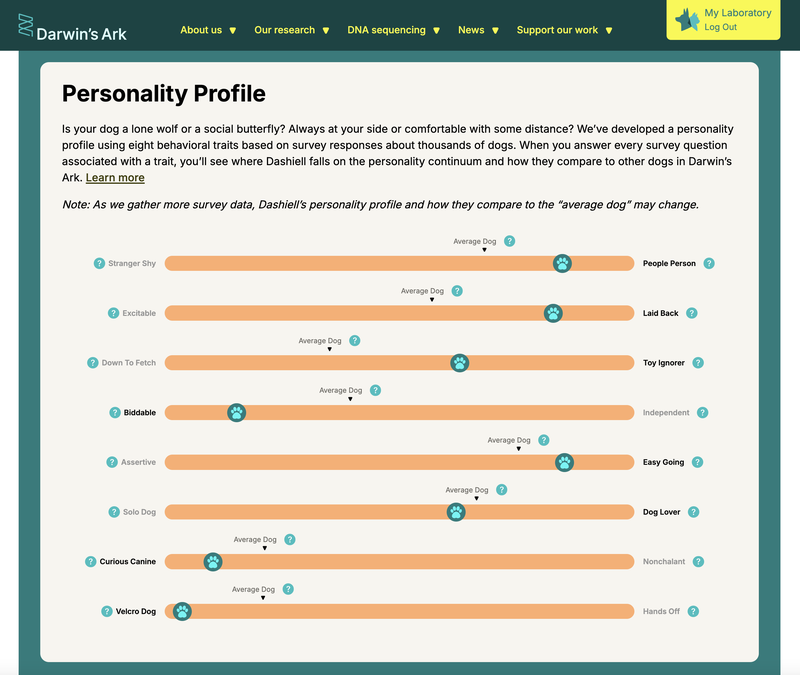
After a brief hiatus, personality profiles are back in Darwin’s Dogs Laboratories! These profiles highlight eight key aspects of your dog’s personality, all based on your survey responses. They also show how your pup compares to the average dog in the Darwin’s Dogs project.
Each behavioral trait is measured on a continuum between two “extremes”. Based on where your dog falls on that continuum, they’re assigned a percentage reflecting how closely they match one end.
Let’s dive into what personality profiles reveal about the ways our dogs experience the world. (To all the cat lovers out there, don’t fret! Personality profiles for cats are coming. Consider this blog post your exclusive sneak peek into the kinds of insights you’ll soon be getting about your feline companions.)
The eight traits of Darwin’s Dogs personality profiles
1. Human sociability: "Stranger Shy" to "People Person"
How comfortable is your dog around people, especially new faces? Some pups have a strong sense of stranger danger, while others solicit belly rubs from anyone and everyone.
2. Arousal level: “Excitable” to “Laid Back”
This behavioral trait assesses how easily your pup gets revved up over exciting situations, and how long they sustain that enthusiasm.
3. Toy-directed motor patterns: “Down to Fetch” to “Toy Ignorer”
How heavily does your dog engage with toys? Research on the ways pups play is revealing how a dog’s DNA influences behaviors like herding and retrieving.
4. Biddability: “Biddable” to “Independent”
Biddability measures how readily your dog responds to instructions. While these behaviors often occur in the context of training, biddability reflects a dog’s eagerness to comply with their human’s requests, not their overall trainability.
5. Agnostic threshold: “Assertive” to “Easygoing”
This behavioral trait looks at how easily dogs react to things they find scary, uncomfortable, or annoying. Some dogs respond quickly to potential threats, while other dogs take it all in stride.
6. Dog Sociability: “Solo Dog” to “Dog Lover”
How comfortable is your dog around other dogs, especially unfamiliar dogs? Some dogs are social butterflies, while others prefer to be lone wolves.
7. Environmental Engagement: “Curious Canine” to “Nonchalant”
How much does your dog interact with their daily environment? Curious canines are alert explorers that constantly seek stimulation, while nonchalant dogs are happy to just chillax.
8. Proximity Seeking: “Velcro Dog” to “Hands Off”
This behavioral trait measures the breadth of your dog’s personal bubble. Some pups are lap dogs while others prefer to keep their distance. Not to be confused with friendliness towards humans, proximity-seeking behaviors are all about dogs’ comfort with physical closeness.
Sit, stay, survey: inside the design of our research questionnaires
To generate Darwin’s Dogs personality profiles, our scientists draw on data from more than 100 survey questions. How do they take jumbled survey data and turn it into reliable insights on eight behavioral insights?
The answer lies in our community scientists’ dedication to completing as many surveys as they can. Darwin’s Dogs designed to collect detailed information from dog owners like you. You might notice that some questions seem to ask about similar things—that’s intentional.
Let’s take human sociability as an example. To understand your dog’s comfort level with people, we ask lots of survey questions: is your dog confident around people? Are they relaxed when greeting people? Do they seek out human companionship? Do they have to greet everyone who comes to the door?
While these questions might sound similar, they each dig into a slightly different aspect of your dog’s social style. Maybe your dog loves people but couldn’t care less about who comes to the door because they’re also a “curious canine” who gets engrossed sniffing around the backyard. Or maybe they don’t typically initiate human interaction, but are eager to befriend people who approach them first. Either way, if we measured human sociability by only one type of expressed sociability, we wouldn’t get an accurate understanding of your dog’s behavior. That’s why we ask lots of survey questions—and why we are so grateful when you answer them all!
But your survey data doesn’t just build personality profiles—it fuels genetic research too. Research using Darwin’s Dogs survey data is starting to prove what our scientists have long hypothesized: there are strong links between genes that influence brain activity and behaviors like herding or retrieving. Even if a dog has never had a sheep to herd, these behaviors often show up in the way they play with toys.
So, do you think we got your dog’s personality profile right? Does it capture how they engage with the world? We’d love to hear your thoughts! Our scientists are always interested in feedback that will help us improve our research. You can reach us at: team@darwinsark.org.
Even with the mountains of survey data we’ve collected so far, there’s still much we have yet to learn about dog behavior. That’s why we’re always adding more surveys to expand our understanding of dog behavior and health. If you want to learn more about your dog—and advance understanding of all dogs’ behavior—head to your Laboratory and take some surveys today. Every answer brings science one step closer to answering the age-old question, “Why does my dog do that?”

