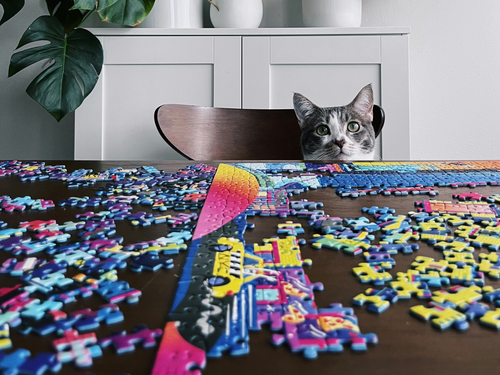


Scientists have pondered the same questions, but there are few definitive answers. Despite being our companions for centuries, our scientific understanding of cats is surprisingly sparse. This knowledge gap inspired Elinor Karlsson—cat lover, geneticist, professor, and co-founder of the community science nonprofit Darwin’s Ark—to launch Darwin’s Cats, a research initiative that combines the expertise of cat owners with that of professional scientists to explore cat behavior, genetics, and health.
According to Karlsson, Darwin’s Cats isn’t just a pet project—it’s an ambitious community science endeavor that could help improve cat health and well-being. “If a ton of people sign up and tell us about their cats, we’ll be able to answer questions about them at a scale that nobody’s done before,” said Karlsson. “I’ve always wanted to research cats, it’s just that everybody will tell you that cats are too complicated. There’s all of this mythology around cats that makes people think they won’t work well for this kind of research.”
Much of that mythology casts cats as collectively aloof, hyper-independent, or mischievous. Some of these stereotypes stem from fruitless efforts to observe cats in traditional research settings, like the vet’s office or a behavioral research lab.
“Anybody who owns a cat knows that if you take them into a new place, they’re going to get really stressed out or they’re going to be excited and want to explore the entire place,” said Karlsson. “Their behavior just isn’t going to be normal. The only way to really know what a cat’s normal behavior is is to study it in its own home.”
Cats are most comfortable in familiar environments, making community science an ideal way to study them. That’s where Darwin’s Cats comes in. Through the project’s online platform, pet parents—the people who know cats best—can answer surveys about their cat’s physical traits, behaviors, and health, and have the option to sequence their cat’s DNA.
By collecting survey responses from thousands of cat owners and DNA data from thousands of cats, Darwin’s Cats hopes to create a powerful dataset that scientists can use to drive scientific discoveries that improve cat health and wellbeing—and also shed light on those confounding behaviors.
Get involved: Join Darwin’s Cats to take surveys about your cat and learn more about participating in feline genetics research.
Cats’ curious behavior
Darwin’s Cats’ behavioral surveys ask a wide range of questions, from: “Does your cat bring prey animals back home as ‘gifts’?” to “Does your cat cross its paws?” to “Does your cat rest in the frog position with their legs out to the side?”