
Darwin's Cats
  • About us
    • Our story
    • Team
    • FAQs
    • Contact us
  • Our research
    • Darwin’s Cats
    • Darwin’s Dogs
    • Data Sharing & Collaboration
  • DNA sequencing
    • Sequence your pet
    • Gift a kit
    • Register DNA kit
    • Instructions
      • Fur kit instructions
      • Saliva kit instructions
  • News
    • Blog
    • Press room
    • Pet of the month
  • Support our work
    • Donate
Laboratory
My Laboratory
Sign up/Log in
Darwin's Ark

About Us

Our storyTeamFAQsContact us

Our research

Darwin’s CatsDarwin’s Dogs

DNA sequencing

Sequence your petDNA kit registrationGift a kitDNA kit Instructions

News

BlogPress roomPet of the month

Support our work

Donate

Join the newsletter

Stay up to date with all of our projects and grow with us.

Follow us

Our partners

Board InstituteUMass Chan

Copyright 2026, Darwin’s Ark

Privacy policyTerms and conditions

Our stories

Blog Home

Blog Home

A breakthrough year for feline science

By Darwin's Ark TeamDecember 17, 2025
behavior

Behavior

cats

Cats

community-science

Community Science

genetics

Genetics

From fur-based DNA sequencing to unprecedented growth, 2025 marked a defining year for Darwin’s Cats.

Cat with white and brown fur stands amid a celebration scene with colorful balloons and confetti

Amid widespread upheaval across the scientific research sector, Darwin’s Cats reached a scientific turning point in 2025. The initiative grew more than tenfold and launched a novel fur-based DNA sequencing method, helping build a research resource that previously did not exist in feline science. These advances now allow scientists to begin asking and answering entirely new questions about cats.

“Cats have historically been underrepresented in scientific research, making these early milestones so important,” said Elinor Karlsson, PhD. “Every new cat enrolled in Darwin’s Cats strengthens the science by pairing genetic data with insights from the people who know their cats best. Continued growth is what makes meaningful discovery possible.”

Underpinning these scientific advances is a rapid expansion in participation and data. Since January, growth across enrollment, surveys, and sequencing has provided the scale needed to support population-level research.

Darwin’s Cats by the numbers
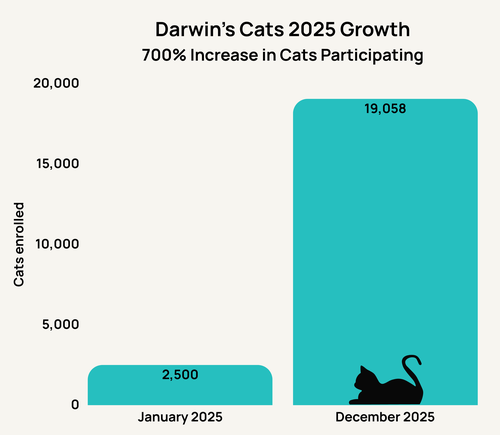
This year, cats came flooding in to join the Darwin’s Cats initiative. Between January and December, the number of participating cats surged nearly 700% and our crew of community scientists grew more than tenfold. As participation expanded throughout the year, Darwin’s Cats began to reflect a far broader geographic and demographic representation of cats and their owners.

Some of Darwin’s Cats’ most remarkable progress in 2025 came from survey data. Community participation propelled the project past one million survey responses this spring, with momentum continuing through the end of the year following the launch of a highly requested health history survey.

In just 12 months, survey responses grew from 140,000 to more than 1.25 million, creating one of the largest phenotypic datasets in feline science. Collecting this volume of phenotypic data (observations about a cat’s appearance, behavior, and health) not only exceeded expectations—it is scientifically transformative. Gathering large-scale phenotypic data is one of the biggest hurdles in genetics research, and yet community science has turned that challenge into one of its greatest strengths. Darwin’s Cats community scientists are powering genetics research in ways that once seemed out of reach.

Advancing DNA sequencing through innovation

Our community scientists’ commitment was the driving force behind several meaningful scientific advances in 2025. As of December 2025, over 2,000 cats have joined Darwin’s Cats’ DNA sequencing research—representing more than a tenfold increase since the beginning of the year. Currently, our scientists are on track to complete sequencing 1,000 of these samples by early 2026. Once 1,000 cat genomes are sequenced and analyzed, our scientists will have a large enough genetic database to begin reporting early findings on population-level patterns like ancestry and genetic diversity.

Related articles

A picture of Balto, one of Darwin's Dogs, walking toward the backyard in his backyard.

What’s Next for Darwin’s Dogs?

Published on September 2, 2026

DNA sequencing is back, and the next chapter of discovery is just beginning.

Read more
The questions that unite pet owners

The questions that unite pet owners

Published on August 19, 2026

From ancestry to aging, the mysteries that fascinate pet owners are the same ones that scientists are working to answer.

Read more

Sequencing participants helped pioneer a first in pet science—fur-based sequencing. Unlike traditional swab-based methods or invasive blood draws, extracting and sequencing DNA from cat fur expands access to genetic research in a way that is less invasive, more scalable, and more accessible for cat owners. This innovation lowers barriers to research participation while maintaining the scientific integrity required for whole-genome analysis.

Building on this breakthrough, Darwin’s Cats began a research collaboration with Zoo New England to explore the broader applications of fur-based sequencing. This partnership is helping researchers evaluate how non-invasive sampling methods can be used not only in companion animals, but also in wildlife conservation and population monitoring—opening new possibilities for ethical, large-scale genetic research.

Building one of the largest phenotypic datasets in feline science

Alongside genomic innovation, 2025 saw major progress in the collection of phenotypic data.

This year, Darwin’s Cats:

  • Launched cat personality profiles, enabling researchers to begin examining patterns in behavior at a population level.
  • Added two new surveys: Feline foodies and Health history.

These tools enable researchers to pair genetic data with detailed, owner-reported insights into behavior, health history, and lifestyle, a crucial step in studying complex traits that cannot be fully understood through genetic sequencing alone.

Looking ahead: reaching the threshold for population-level discovery

In 2026, researchers will begin translating the survey responses and genomic data collected through Darwin’s Cats into scientific discovery. Early analyses will focus on population-level questions surrounding ancestry and genetic diversity. As Darwin’s Cats continues to grow, the dataset will support increasingly complex research, including investigations into genetic and environmental influences on behavior and disease risk. These areas of study require large, diverse datasets to explore responsibly.

Darwin’s Cats is entering the next phase of its work—where community-powered science begins to unlock insights that can improve our understanding of feline health and biology. None of this progress is possible without the participation of community scientists, whose continued involvement will shape the discoveries still to come.

As the year comes to a close, we are deeply grateful to the community scientists whose participation made this work possible.