


One of the most meaningful ways that Darwin’s Cats community scientists help advance our research is by sharing what they know best—observations on their own cats. Each time you submit a survey, you’re adding an important piece to the larger puzzle of feline behavior. And when thousands of cat lovers contribute, those pieces come together to paint a picture of the incredible range of behaviors across the pet cat population.
Survey insights are an essential part of our genetic research, but we also use them to showcase the paw-someness of our participating cats in a new feature available in your Darwin’s Ark Laboratory: personality profiles.
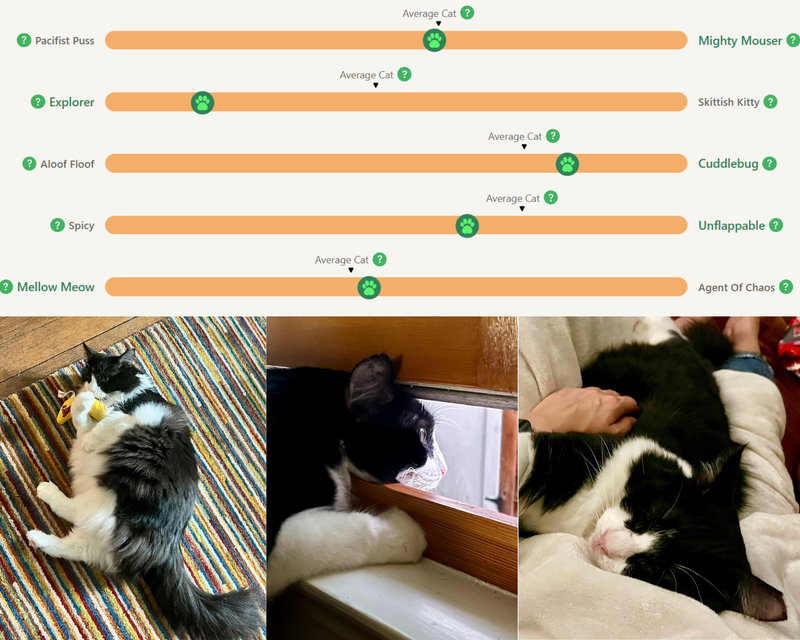
Darwin’s Cats personality profiles spotlight five key aspects of your cat’s behavior, each measured on a continuum between two “extremes.” Based on your survey answers, your cat’s personality profile places them along the behavioral continuum according to how closely they match one of the two ends. It also shows where your cat falls relative to the “average cat" in Darwin’s Ark.
To create your cat’s custom personality profile, our scientists analyze your survey responses along with those from thousands of other cat owners. As our survey data and research findings grow, we expect our cat personality profiles will evolve, and as a result, your cat’s results may change. But for now, you can pounce over to your Darwin’s Ark Laboratory to see our take on your cat’s unique traits.
Darwin’s Cats personality profile factors
Each of the five behavioral factors in your cat’s personality profile is based on your responses to a set of related survey questions. Here’s an overview of each factor:
1. Hunting motor patterns: Pacifist Puss to Mighty Mouser
How heavily does your cat engage with toys? Are they captivated by small prey like birds and mice (or objects that resemble prey, like a leaf fluttering in the wind)? Your cat’s enthusiasm—or lack thereof—for stalking, chasing, and pouncing can offer insights into their natural hunting abilities.
2. Responses to novelty: Explorer to Skittish Kitty
How eager is your cat to investigate new experiences or familiarize themselves with new people? Cats vary widely in how they approach the great unknown, and their behaviors can reveal how receptive they are to change and novelty.
3. Proximity-seeking behaviors: Aloof Floof to Cuddlebug
This behavioral trait measures the breadth of your cat’s personal bubble. Some cats love to cuddle while others prefer to keep their distance. Not to be confused with friendliness or sociability, proximity-seeking behaviors are all about a cat’s comfort with physical closeness.
4. Annoyance threshold: Spicy to Unflappable
This behavioral trait looks at how easily cats react to things they find scary, uncomfortable, or bothersome. Some cats respond quickly and strongly to potential threats, while others take it all in stride.
5. Excitability and biddability: Mellow Meow to Agent of Chaos
This factor evaluates two elements of feline temperament: how easily a cat gets excited, and how responsive they are to their human’s cues. Some cats are calm or compliant even amid stimulation, while others get revved up so easily that it’s hard for them to receive any external instruction. Together, these traits reveal how your cat balances impulse and cooperation.
Personality profiles in action
Here's the personality profile of Gus, a Darwin's Cat participant. Based on these photos, it's safe to say that Gus's results are a pretty purr-fect encapsulation of his personality!
Enhancing our understanding of cat behaviors
The behavioral factors spotlighted in Darwin’s Cats personality profiles also have a research purpose. By analyzing survey responses across multiple behavioral dimensions, we can start to map the vast landscape of feline behavior in a systematic way. Understanding the range of cat behaviors and how they differ among individual cats is an essential first step in our research.
Once we have a clearer picture of how behavior varies among individual cats, we can explore why these behaviors vary. How do age, sex, or other covariates influence cats’ behavioral baseline? For example, we already know that many behaviors change over time as cats age: older cats tend to display fewer hunting patterns than young frisky kittens. Yet age is only one piece of the behavioral puzzle; Darwin’s Cats’ research aims to uncover how more complex factors—like environment, socialization, and genetics—shape behavior.
As Darwin’s Cats grows, larger sample sizes will allow us to refine our surveys and dig deeper into the roots of variation in cat behavior. How much do environmental factors, such as the presence of other pets in the home or outdoor access, shape a cat’s tendencies? What role do genetics play in predisposing cats toward certain behaviors, like strong hunting motor patterns? To what extent is behavior innate, learned, or a dynamic response to changing surroundings?
The answers to these questions could transform how we care for our cat companions. For example, if stress-related behaviors turn out to be strongly associated with environmental factors, such as a lack of enrichment, we can use those insights to enhance their daily stimulation to foster calm and curious behaviors. Similarly, identifying genetic predispositions to behaviors could help veterinarians personalize care to each cat’s unique temperament and needs.
Unraveling the biological and environmental forces behind cat behavior can bring us closer to understanding what our cats truly need to thrive. The more we learn about what drives their behaviors, the better equipped we will be to create homes, relationships, and veterinary care practices that help cats live healthier, happier lives.
We’d love to know what you think about Darwin's Cats personality profiles. Do your cat's results reflect your observations of their behavior? Were there any surprises? Other behavioral traits that you’d be curious to see? Share your thoughts here.

